
Firsts in Flight

In 1903, a dynamic duo of brothers who owned a bike shop demonstrated the first heavier-than-air flight.
120 years earlier, just as the American Revolutionary War had just drawn to a close, and four years before the Constitution was written, the first human beings flew overhead in a controlled manner. Their names were Jean-François Pilâtre de Rozier and François Laurent d’Arlandes, and they flew in a hot air balloon.
This was different, though. Unlike hot air balloons, airplanes could ultimately fly in whatever direction they wanted—or, at any rate, they could better negotiate with the wind instead of doing whatever the wind wanted.
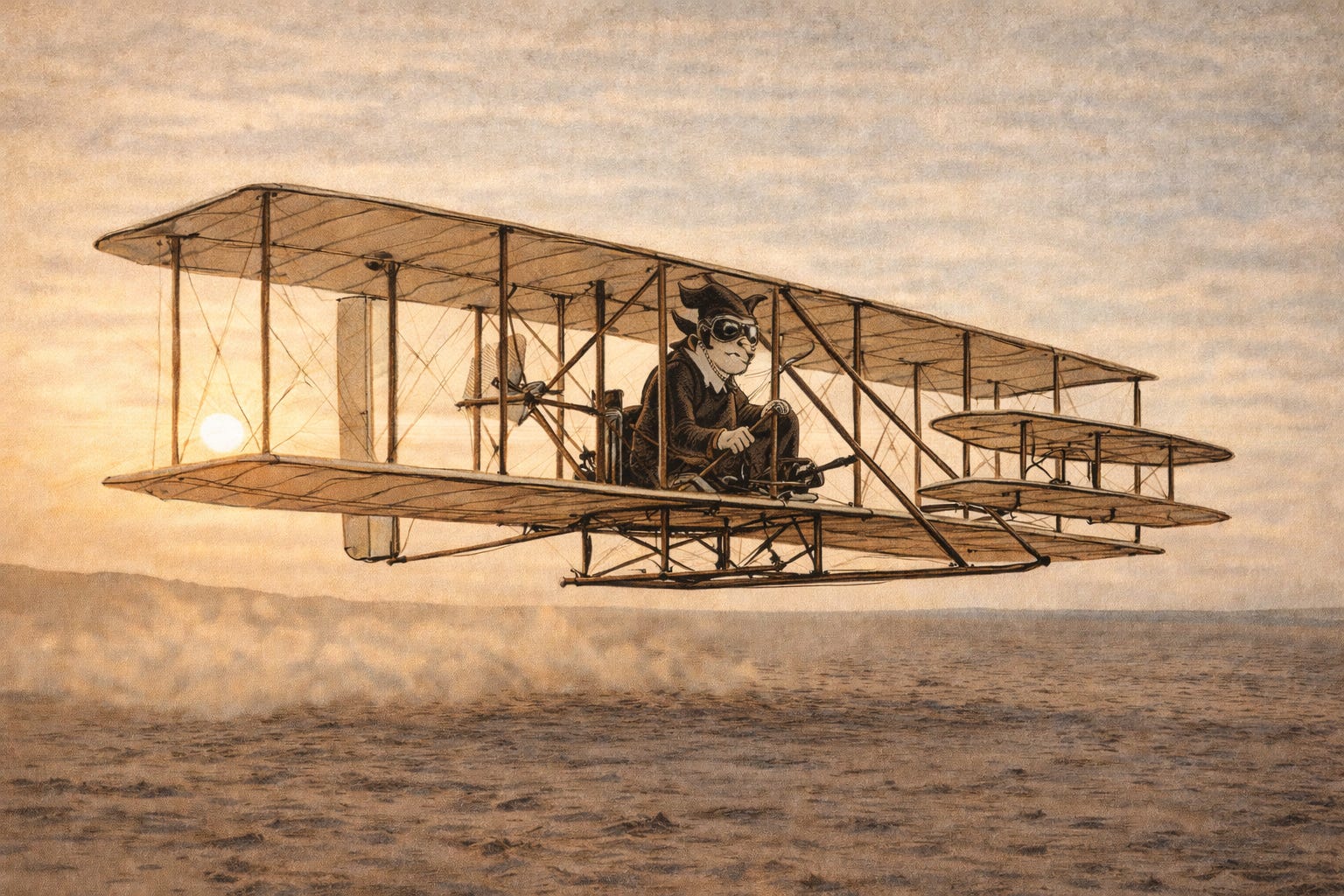
It turns out that Earth’s atmosphere is great for either of these methods of flight. Balloons are able to stay buoyant because of the thickness of the air, and airplanes can fly thanks to this same property.
Earth’s gravity, by contrast, sucks for flying. You start to get a little bit of lift, and immediately one gravitational force is pulling you back down. It seems like a planet with less of this sucky force might be even better than Earth for flying.
Interestingly enough, our rocky planetary neighbor has a much better situation for gravity, but a way worse situation for atmosphere—at least as it pertains to controlled flight.
You might be thinking that it doesn’t make much sense to say “heavier-than-air” flight since Mars doesn’t have air, but it actually does have a thin atmosphere. This means it’s technically possible to have both balloons and powered, controlled flight on the red planet.
You might also think balloons would come first, just like here on Earth, and this would be an excellent deduction. In 1996, a Russian mission to Mars carrying two test balloons was launched into space. Unfortunately, the upper stage of the rockets failed to ignite properly, and most of the debris from the project ended up in the Pacific Ocean (though some apparently landed in Chile and Bolivia).
Now you’re thinking: why didn’t they just go back up with more balloons? Fair question.
The answer is two-fold. First, the lower gravity on Mars really did provide a structural advantage over balloon flight on Earth. Unfortunately, this was more than made up for with the thinner atmosphere, so you ended up needing an enormous balloon if you wanted to float in Mars’s atmosphere.
Second, the late 90s and early 2000s were a real turning point for engineers working on drones, especially quadcopters.
Suddenly, lightweight motors that were powerful enough to do the job appeared. Battery technology improved, and hardware met software improvements in autonomous stabilization. By 2021, it was time for the first ever controlled flight on the surface of Mars, and it was the method first used by the Wright brothers that would win the race this time.
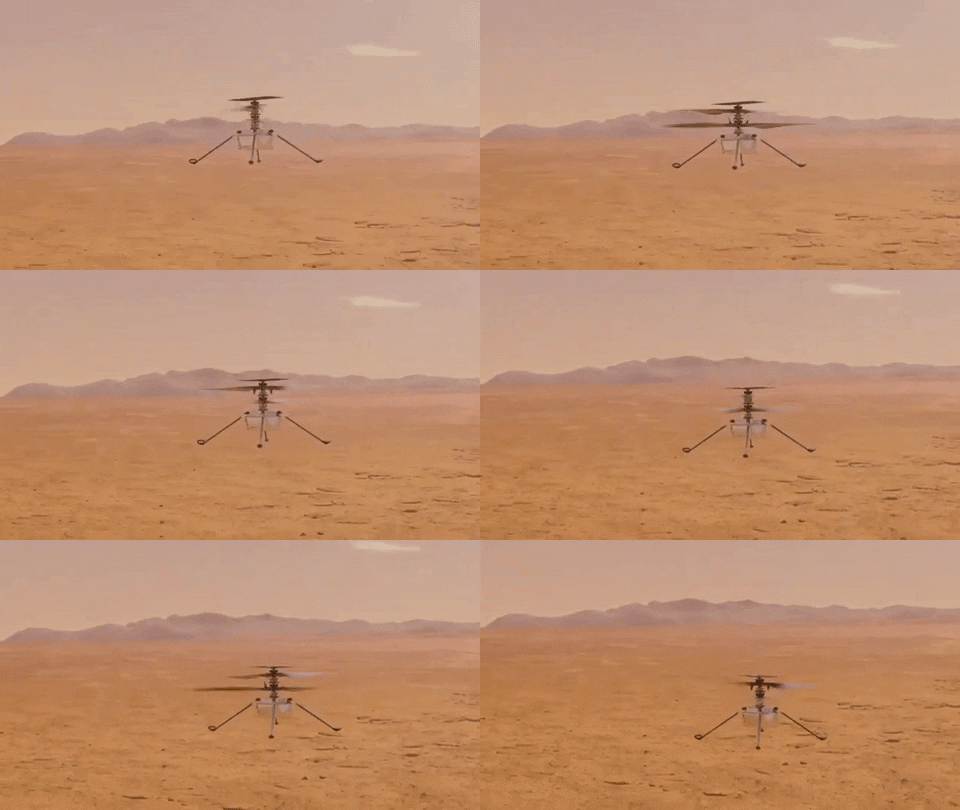
Well… it was a helicopter, not a fixed-wing aircraft like the Wright brothers used, but: it was powered, heavier-than-air flight, and it honored the Wright brothers’ world-changing innovation in another notable way, too.
The Ingenuity—the solar powered helicopter drone—carried a tiny piece of the original 1903 plane the Wright brothers had flown on that very first flight.
So, the Wright brothers plane participated in the first controlled, heavier-than-air flights on the first two planets in our solar system to host controlled flight.
The Wrights made their living repairing bicycles before they discovered airplanes, and surely their understanding of the bicycle's construction mechanics influenced the manner in which the early airplanes lumbered through the air like airborn bicycles.
I'm biased, but I think everyone should visit Kitty Hawk at least once. Walking the length of that first flight puts a lot into perspective.