
Gettysburg

Three score and eight years ago, right as the centennial of the Civil War approached, a company named Avalon Hill published a game called Gettysburg. This game was dedicated to the proposition that it would be fun and intriguing to faithfully recreate old battles.
Avalon Hill is already a familiar name to me because Young Andrew’s friend Matt had the game Titan. This was a board game I probably last played about 40 years ago. Players used chips that were made of rigid, high-quality cardboard with a monster from mythology or fantasy, and there were dice whenever these creatures fought one another.
Titan wasn’t quite role-playing, but it had a lot of the elements from D&D. So did Gettysburg, though the fantasy aspect was missing.
Dice were present, though. Why dice, and why do I bring them up?
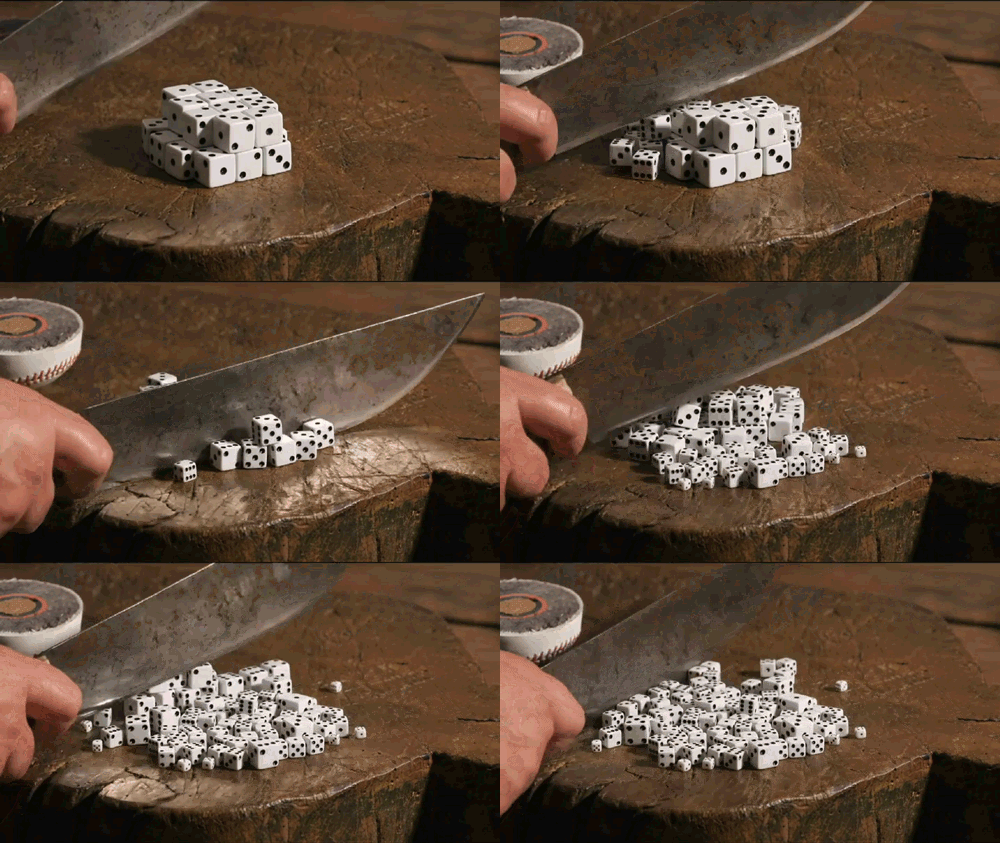
Well, dice introduced the element of probability to the board game. Gettysburg’s creator, Charles Roberts, understood that there wasn’t certainty whenever two sides clashed, so chance needed to play a role here, just like it did in real life.
This wasn’t a new idea. Tactics, Roberts’s earlier brainchild, had involved dice and chips. Gettysburg was notable because it was based on an actual historical battle. These were the actual military units that had been in combat a hundred years earlier.
Suddenly, full immersion was possible. You could really lose yourself in the minute details of the past, seemingly caring as much about the outcome as though you were there yourself.
This was a vivid role-playing experience, albeit one constrained by the rules of the game.
Gary Gygax loved this.
Gary would eventually go on to create Dungeons & Dragons, along with his friend Dave Arneson. For now, though, he was in love with this game, and it was steadily ruining his marriage. No, really: his wife, Mary Jo, was positive Gary was having an affair with another woman.
He was having an affair, all right—but with a game, not a woman. She burst in on a session one day, and while the immediate situation was alleviated, Gary’s complete obsession became all-consuming.
This led to hacking the game and creating his own modified rules set. Eventually, Gary teamed up with his friend Jeff Perren, who was deeply immersed in games involving miniatures—tiny physical representations of the person or unit you were controlling in the game.
This wasn’t D&D yet, but instead a game called Chainmail.
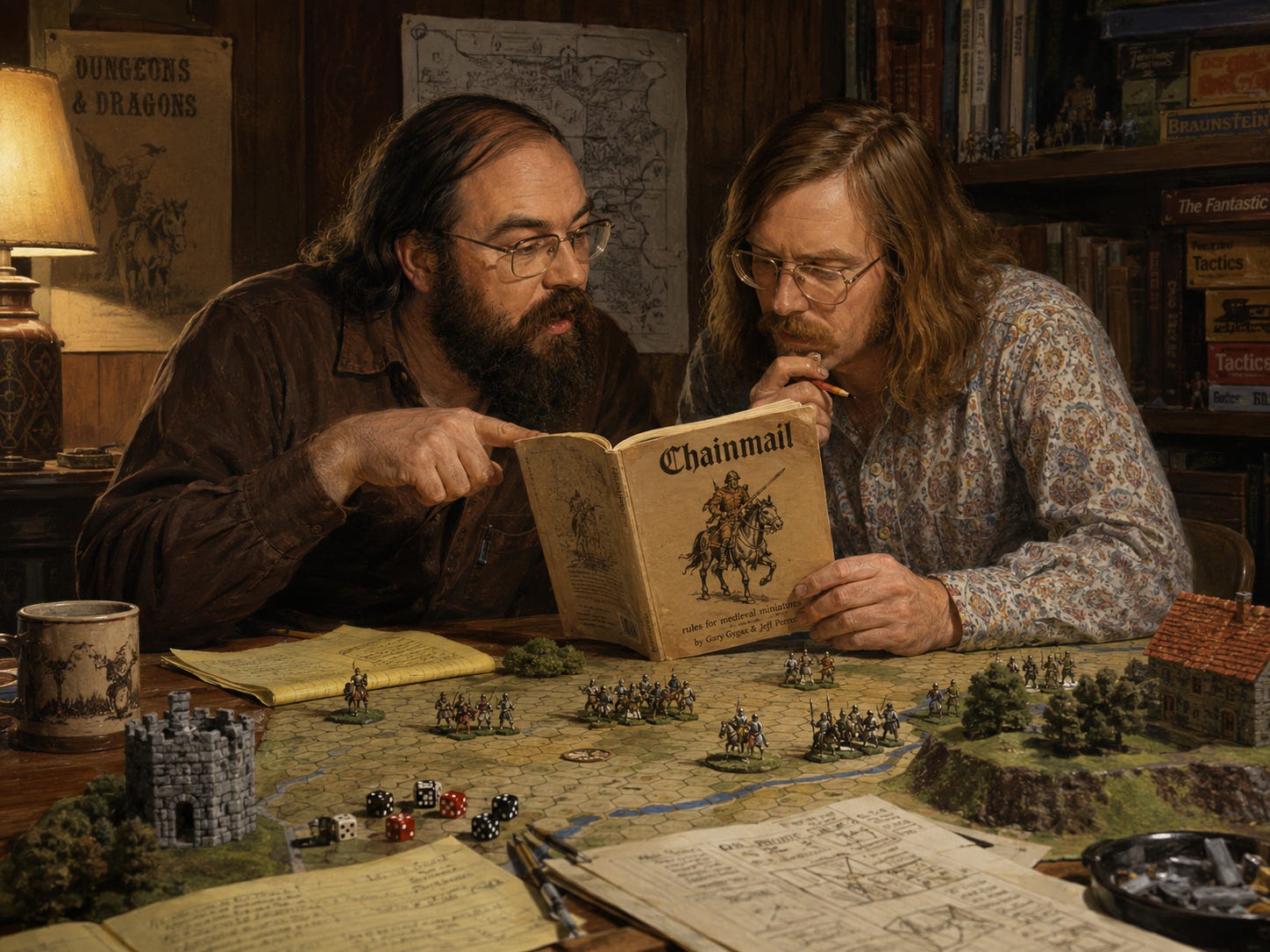
CM had the now-familiar medieval fantasy setting, and it dealt specifically with one-on-one combat—a feature of modern role-playing games and (of course) of D&D today. The combat rules of CM were, basically, proto-D&D rules.
Something was still missing, though.
Enter Dave Arneson, co-founder of D&D with Gary. Dave’s Blackmoor game borrowed from Chainmail’s rules for combat, but it drew upon other sources too, like the Lord of the Rings universe, which would eventually result in a scary cease-and-desist letter (for TSR) followed by a bunch of D&D book rewrites. Hobbits became halflings.
Dave also added something truly notable—the very thing that caused me to fall in love with D&D myself 40 years ago. It was the ability to play the role of your character in the game. It wasn’t so much that you could act out their role; it was that you would try to think like them in the moment.
Even more notably, you could do anything you wanted. Find yourself in a tavern? Want to knock someone’s glass over or go pee in a corner? You can do that.
This combo was a huge hit.
Eventually, Gary and Dave worked together to formalize the rules that had coalesced during Dave’s Blackmoor campaign. This was the seed for D&D.
Many people in the U.S. DO recreate these battles, but not with a gameboard...
I’ve always thought that Gary Gygax is a cool name and perfect for a co-creator of D&D.