
How Much Gold Does Smaug Have?

This definitely isn’t Smaug, the enormous and powerful dragon from the mind of JRR Tolkien, but it’ll do for today.
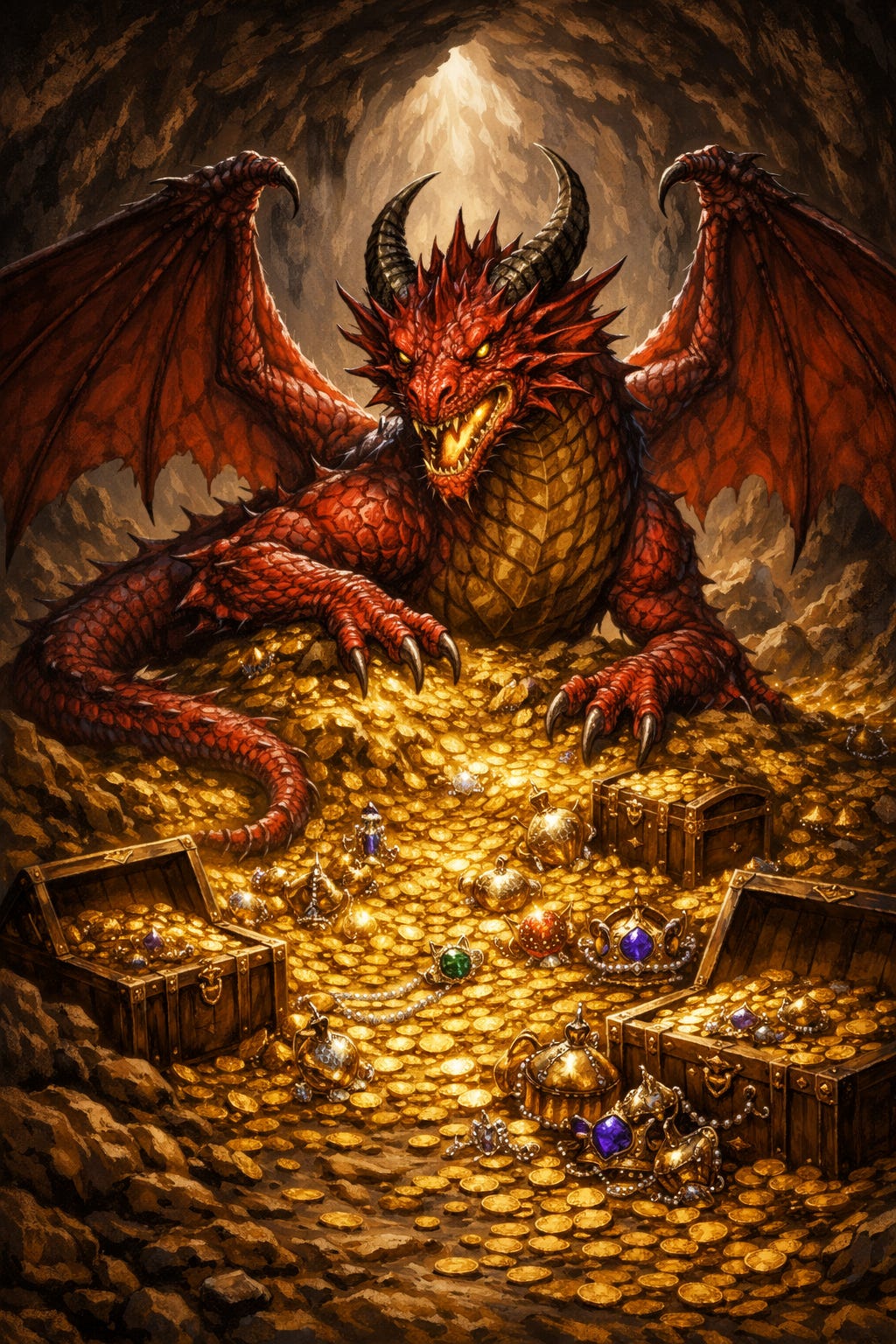
Let’s name this fellow. I’ll call him Not-Smaug for the rest of the day.
Not-Smaug has a lot of gold, doesn’t he? If I asked you to estimate how much, just based on what we can see here, where would you start? This is an ample sample: we can get an order-of-magnitude estimate just by looking and thinking, just as Laplace estimated the average depth of the world’s oceans by careful observation and inference.
It seems overwhelming and near-impossible, but we can start by considering the things we do know from just this one look inside Not-Smaug’s enormous hoard. For one thing, there are crowns and treasure chests, both of which give us a sense of the scale of the pile as compared to a human being.
What we have here is essentially a pile of gold, and there’s no simple formula in geometry to calculate the volume or mass of a pile. Fortunately for us, though, a pile is a lot like a hemisphere—half a sphere, where the ground bisects what would otherwise be a sphere shape.
If the biggest crowns are about a foot wide and high, maybe the biggest chests are nearly a meter wide, or about three feet. Any bigger than that and it’s hard to imagine how even two very strong people would be able to pick a chest up, so there must be some limit as to how big these can be.
Not-Smaug’s hand seems to be about that same width, and it appears as though the dragon himself is around five hands wide at the torso, so maybe ten or fifteen hands wide with the wings spreading out like that. Those wings look like they just about cover this treasure hemisphere, don’t they?
If we go with one hand being roughly a meter, that would indicate that the hemisphere is around 15 meters wide, give or take. Let’s use that number as a best guess, and calculate the volume of this pile.
Actually, forget I said that. Half of 15 is 7.5, so let’s be really lazy and use 20 meters for the width of the pile. It could be 20 meters, right?

That gives us a clean 10 meter radius, perfect for plugging into this formula for calculating the volume of a hemisphere:
V = (π · h^2 · (3r − h)) / 3
We’re keeping this simple, so we’re imagining that the height and the radius are the same. In reality, Not-Smaug could be standing on a fairly short, wide pile, but I can’t tell from the image, so we’re going with the laziest possible assumption. That means we can simplify to this:
V = (2/3) · π · r^3
Man, making the radius 10 was a good decision. If I’m even lazier and assume pi is 3 (close enough for what we’re doing), I can do this in my head. Our volume is 2000 cubic meters.
See how one lazy fudge went up and another went down? That kind of quick balancing act can allow me to move pretty quickly through this sort of exercise.
Now, if that gold was a solid piece of metal, it would be ridiculously heavy—but there’s going to be some space in between the coins, crowns, and other various objects made of gold that will leave some bits of space. I’m going to guess the pile will still be incredibly dense, though. Let’s call it 75% as dense as solid gold.
The internet knows that the density of gold ≈ 19,320 kg/m³. 2000 cubic meters of solid gold would come to about 38,640,000 kg. 75% of that is 28,980,000 kg.
Gold is sold in troy ounces, with about 14.58 troy ounces to a pound. One kg is about 2.2 pounds. So, 28,980,000 kg of gold is about 929,562,480 troy ounces. Let’s just round that up to a billion, since we’re fudging a little anyway.
A troy ounce is worth around $5000 as I write this. $5000 multiplied by a billion ounces gives us an economic value of $5 trillion for Not-Smaug’s gold.
Estimation jars are so much fun. JFran uses them with her elementary kids - usually filled with Hershey kisses or some such. Better than gold to a 6yo. I remember one from elementary school. Rachel’s work does one every Xmas which is weird - they’re a tech company! but everyone loves it. I sent the picture to chatGPT and it was so far off. Last year she won - her guess was closest (actually she dead-heat tied someone) and she got a bitchin lego set.
I have studied piles as a part of my self-education in Complex Systems (via online courses from the Sante Fe Institute). https://www.santafe.edu/research/results/working-papers/the-computational-complexity-of-sandpiles
The "sand pile model" is a foundational concept in complex systems theory used to explain how systems, such as economies, ecosystems, or power grids, naturally evolve to a critical state where minor disturbances (like adding a single grain of sand) can cause massive, unpredictable consequences (avalanches). Introduced by physicists Per Bak, Chao Tang, and Kurt Wiesenfeld in 1987, it illustrates Self-Organized Criticality (SOC)