
Jute and Twine

There’s a plant called jute that grows like mad in the Bengal region of what is now India and Bangladesh.
This wasn’t a plant I was familiar with—or at least that’s what I thought. It turns out that I’m very familiar with the finished product of jute. I know what it feels like in my hands, how strong it can be, and how useful it has been for me.
Jute grows tall and straight up out of the ground, like a reed. However, unlike reeds, this plant has a solid stem that runs up the length of the plant. This stem is surrounded by a bark of sorts that consists of bast fibers, these long useful strips that run up and down the outside of the plant.
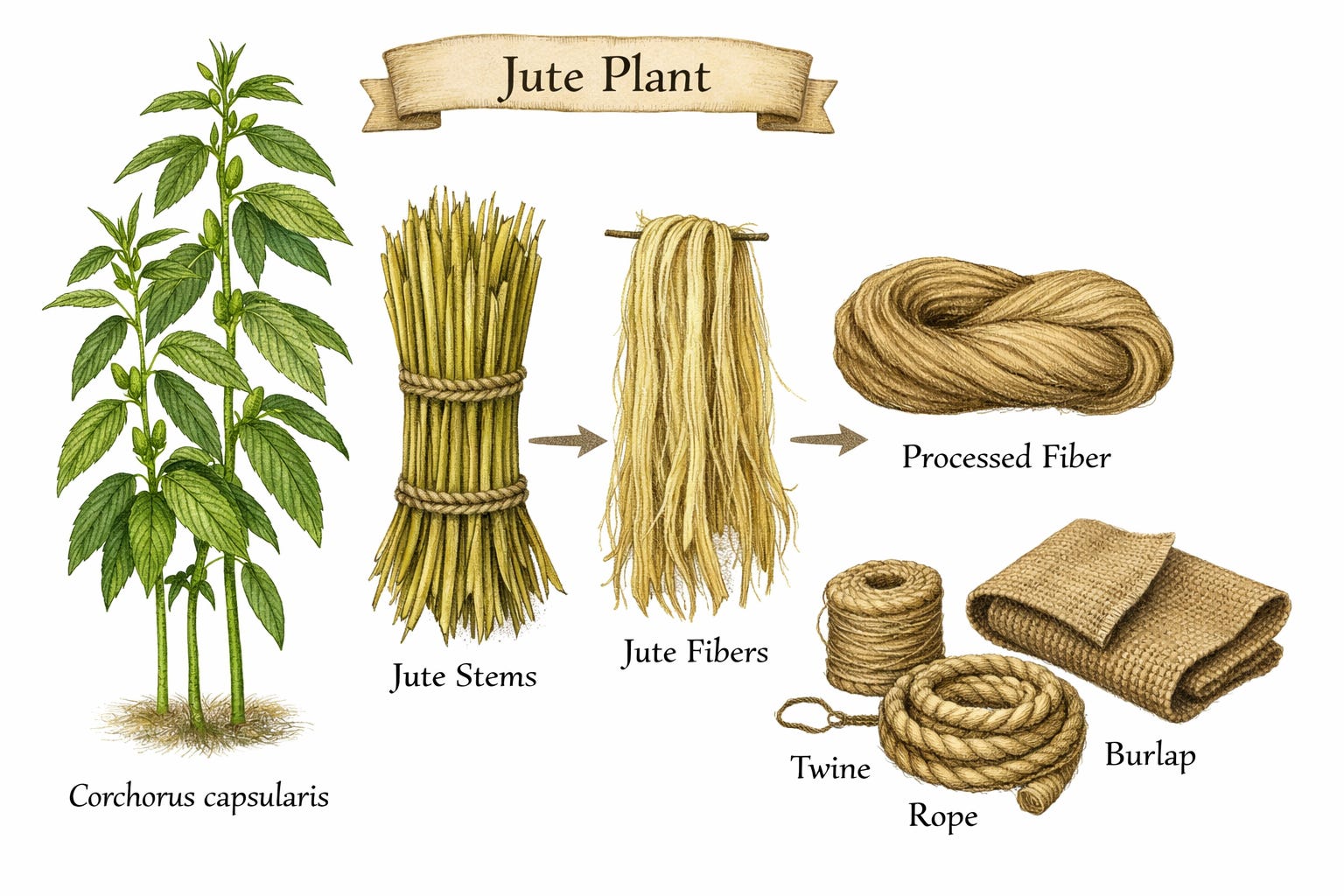
Since jute grows in the Bengal region, it was naturally harvested by local ancient humans living in the region. Beginning around 4000 years ago, people began to organize their society around this incredibly useful fiber.
Those long strips could be spun into thread, and threads could then be twisted into twine, or woven into coarse cloth, like modern burlap today (often made from jute). The burlap could be used to make sacks for grain storage, or it could make coarse, warm clothing.
In the Bengal region, necessity was often the mother of invention, and twine made from jute was frequently a part of the creative answer that arose.
Now, you had a way to bundle things together. You could tie pieces of wood together and make a decent boat, good for local trade—or for fishing. You could make a net for catching fish. And, you could make a sack to store those fish in once they had been dried.
This provided a physical structure for the society, and you could find jute everywhere. Neighboring communities eventually began to take notice. They would be interested in trading for this useful twine or burlap.
I don’t know if jute was a necessary ingredient in the rise of the Indus Valley civilization, but just as rice contributed to the rise of China, it was certainly a big factor. Trade drove even further innovation, all made possible by the hidden infrastructure of twine and woven jute.
Fast forward to only 200 years ago. The industrial revolution is roaring along in Britain, but they need jute.
Why? They had a globe-spanning empire, and they wanted to trade with everyone, everywhere. This meant a great deal of shipping of goods, and you needed some way to store all these goods that would be shipped across oceans and seas.
The UK had established a strong foothold by force in the region, so it was natural for them to connect Bengal with Dundee in Scotland, where the lion’s share of jute was spun into durable sacks and bags, ideal for shipping all manner of goods everywhere in the world.
Jute had once again become the hidden infrastructure of a civilization’s rise to dominance, although this time, it was global dominance.
Jute & Twine......pretty sure I saw them in a Greenwich Village coffee shop in an afternoon show on a Sunday! Can't understand why they never recorded!
When I was in high school there was a gang called the Jutes that caused havoc in our small city