
Mongol Money

While carrying newspapers, I got to know the homes in my neighborhood really well. In order to amuse myself while walking from yard to yard, I’d make little observations about their lawn, house, or what sort of car they drove.
This is almost certainly how I learned about the word fiat.
Fiat is an automaker founded in Torino, Italy in 1899. The name itself is an initialism standing for Fabbrica Italiana Automobili Torino. Fiats were one of the least common brands around me; I’d see Volvos or Saabs here and there, and maybe even the occasional Porche among the Toyotas and Nissans most folks drove. This was the suburbs, and everyone had kids.
Well into my 30s, the word fiat would still conjure up the idea of those tiny iconic cars. Eventually, I learned a little Latin and discovered that fiat means something like let it be done or so it shall be. This makes perfect sense given the way the word is used in the world of finance and economics today.
Fiat money is money that exists because the state says, effectively, so it shall be.
This seems pretty modern, right? Isn’t money supposed to be backed by silver or gold? That line of questioning got me thinking about when the first large-scale experiment in fiat could have been.
The answer seems to be the Yuan dynasty in China, from around the time of the early 1300s. But: why Yuan China, and why then?
To answer this, let me invoke tokens for a moment. Remember this thought experiment from last week?
What if there was some way to symbolize a bushel of grains so that you didn’t have to lug it around with you everywhere you went? What if you could just swap that token for a real bushel of grain any time you wanted?
This invention led to clay accounting tablets, then smaller pieces of pottery that represented physical goods, and eventually to coins made from precious metals. By the early 1000s, Song dynasty China had begun to experiment with printing paper money. Wood block printing in China had been around for several centuries now, so it was natural to try to lighten those travel loads with paper.
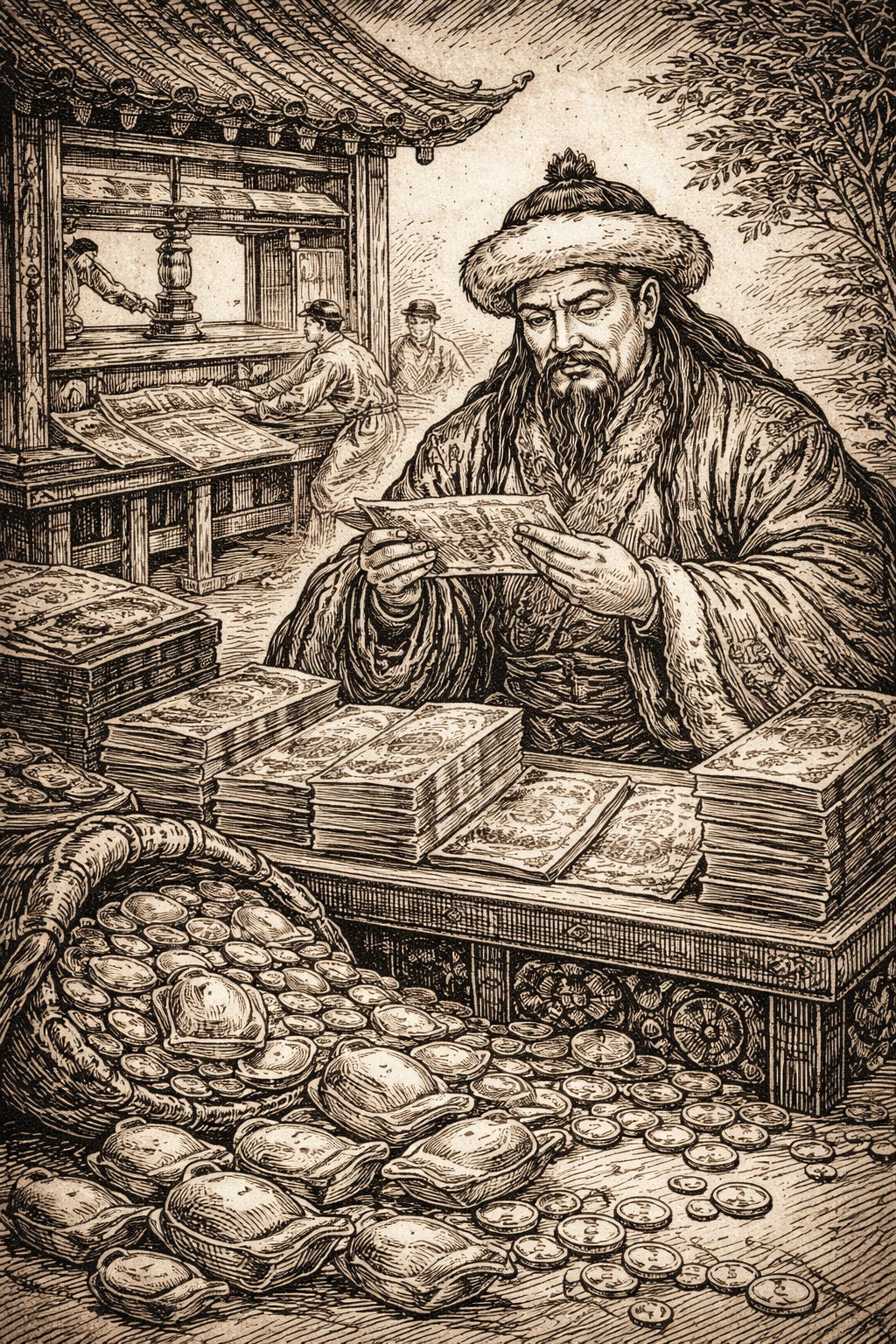
Of course, that paper ultimately represented “real money”—silver, which the state would use to settle very large sums from time to time. This substantial weight let you know it was tangible and real, but paper had its appeal too: you could transfer a great deal of money across wide distances far more easily with a pound of paper than with a thousand pounds of metal.
Eventually, more and more people used the paper notes just like they’d use the coins.
And here is the real crux of the essay today: there wasn’t always enough silver to pay out to someone who came in with a lot of notes. What do you do if you’re the emperor and you can’t redeem the notes?
One easy solution was to just say those notes were fine, and they could be used for legal tender just like the coins could. This sort of idea had happened previously in empires all over the world, but it was generally very ad-hoc since there weren’t tons of instances like this. The printing press had changed all of that, since there were now millions of notes in circulation all across the Song empire.
This is the state of the empire when the Mongols entered the chat. In 1271, a new dynasty was born: the Yuan. Kublai Khan declared himself emperor, tipping his hat to what the Mongols saw as the epicenter of culture and choosing to rule under Chinese traditions.
You could say that fiat had already been creeping in with the advent of paper money, but 1310 stands out as a stark line for historians. It’s not so much that the Mongols stopped converting notes into coins after that, but silver would no longer play the role of reserve.
While this was already happening organically, it was something entirely different for the state to create money out of thin air, but that’s what eventually happened.
Today, we are all using Mongol money. Nearly all currency everywhere is fiat, and the Mongols were the first to try it at scale.
I once caused a stir at my job by claiming management was making decisions "by fiat."