
My Beautiful Selfish

“Leave your ego at the door.”
You are very likely to see a slogan like this at a martial arts school. On the fairly obvious hand, this is a great sign: this gym is interested in downplaying the role of the ego in training, which means not striking back in frustration when something doesn’t go your way.
It means showing up not with the expectation of beating everyone on the mat, but instead of learning something from those experiences. It means being grateful there are people who can beat us up regularly, for we know those are the training partners who are going to make us better.
On balance, it’s important to have some pull in this direction, away from the ego. However, it might surprise you to hear me say that I don’t think ego is all bad. In fact, I think it’s necessary and important—the key is the right balance of confidence and humility.
This was first pointed out to me by a friend in jiu jitsu named David Jacobs. Dave passed away in 2018, but he left a small but profound impact on my thinking. We had become friends over the last couple of decades as people crazy enough to obsess over sport jiu jitsu, back during a time when virtually nobody was doing it.
Dave was always someone I looked to for wisdom. He was an older grappler, and his body had been around the block a few times more than me, so whenever he spoke about mat wisdom, I listened… but Dave’s thinking extended way beyond the jiu jitsu mats.
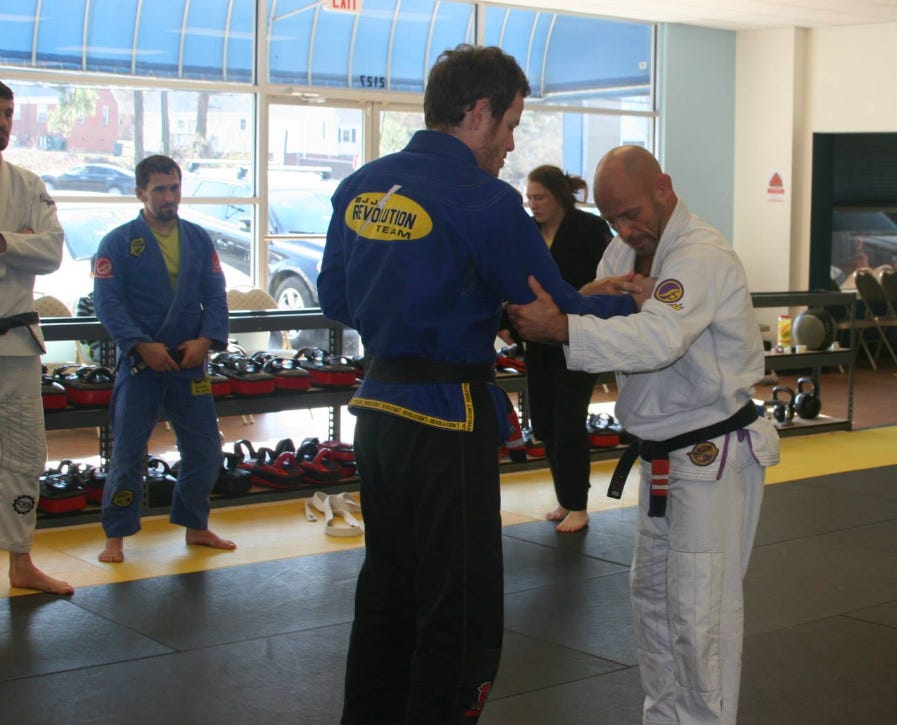
On the subject of ego, Dave had what might be called a hot take today. His point was that ego wasn’t just unfairly demonized; it was an important ingredient in anyone’s jiu jitsu game.
Dave’s contrarian observation about ego caught me off guard. Dave presented himself as very humble, always deferring to the skills of others around him, even while he amassed his own impressive competition record, beating some of the legends of the sport right in front of me.
What he was driving at, though, was that ego is what makes you show up in the first place. You’ve got to be just arrogant enough to step onto the competition mats, and this even extends to starting a new art in the first place.
Part of the problem here is that everyone has their own idea of what ego really means. Originally, the Latin word ego meant simply I—if you say ego sum, you’re saying I am.
Having a word for I separated what was inside (you) from the outside world, and ego came to mean how those two forces interacted. By the end of the 20th century when I finally arrived on the scene, ego was all about how you presented yourself to other people, and what you thought they thought of you.
This is the version of ego that Dave was saying wasn’t all bad, and even necessary. I think about this all the time today, and I have to admit that Dave was right. Caring what others think about you can be very motivating, especially if you also care about those people. Ego—the way you see others as seeing you—has been a necessary component of every one of my major endeavors.
Here I am on Substack, using my ego to get feedback from you on today’s piece:
Here’s the Sex Pistols song No Feelings, from whence today’s title comes:
I’ve got no feeling
No feeling
For anybody else, except for myself
My beautiful selfish
This is very much that cautionary side of too much ego, isn’t it?
Yet, if you ignore your ego, you do so at your peril. Rest in peace, Dave.
Ego good although mine has mellowed a lot with age. Less stress too.
It's a little cringey to read stuff I wrote only a year ago but there's this
https://newsletter.wirepine.com/p/how-much-ego-is-too-much
"Leave your Igor at the door." - Dracula Convention 2025.