
Shills and Shilling?

Remember shillings?
If you’re like me, you know the name and that it’s a British coin—but not that shillings were retired as a denomination in Great Britain after Decimal Day on February 15th, 1971. They’re still used today in Kenya, Tanzania, Uganda, and Somalia, but the UK phased them out due to the weird way shillings fit in with the rest of British currency.
The name of the solution the British government chose tells you what needed to change: decimalisation. Happy Decimal Day to all who celebrate, though we are two days late as I write this.
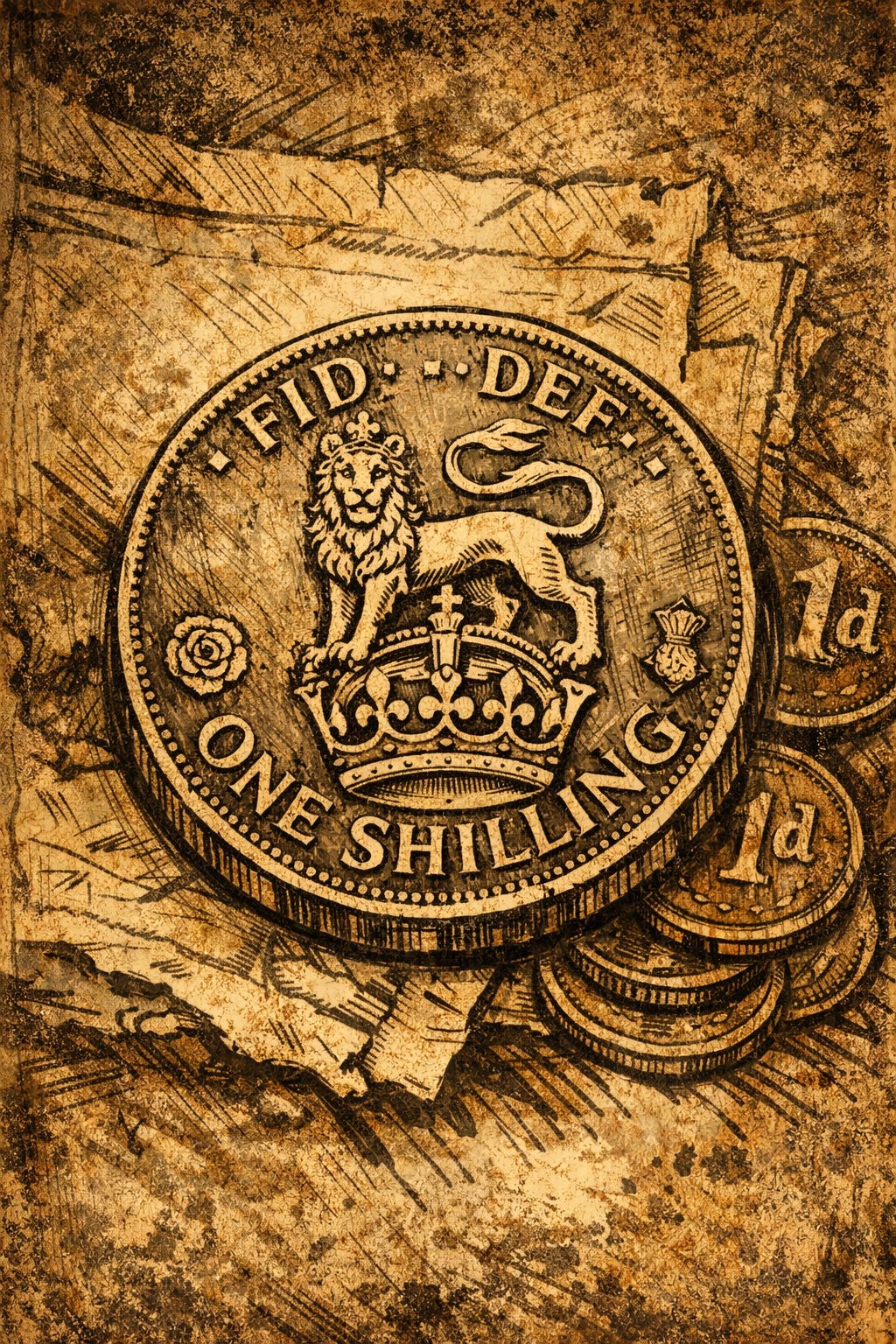
I said that the shilling wasn’t used in Britain after 1971, and that’s true—but the shilling coins definitely were. That’s because they were revalued as 5 new pence, kind of like a nickel in American currency. Prior to this update, shillings were valued at 12 pence each, and there were 20 shillings in a pound.
Math is way easier if you count everything in multiples of ten. If you have to reckon with 12 and 20 on the fly, you end up doing a lot of mental gymnastics just to calculate a price.
Decimalisation fixed all of this, and the shilling rebranded itself to the five-new-pence-piece, which was ultimately shortened to 5P most frequently. Then, on December 31st, 1990, this coin was retired forever.
Shillings hadn’t been around forever. It was only during the reign of King Henry VII that the coins became official currency, although they had already been introduced as a unit of account centuries earlier.
Why the word shilling, though? I was initially sure the verb to shill has something to do with the currency. After all, both the noun and the verb represent taking money from one party and giving it to another, right?
I was way wrong.
Shillings (the currency) arose from the Old English scilling, which itself arose from Proto-Germanic *skillingaz. Linguists have theorized that it meant to split something, or a slice of something, but it’s all fairly speculative.

To shill, on the other hand, is fairly modern US slang. There are shills out there trying to con you out of your money, and if someone is shilling, it’s generally best to avoid them. This meaning arose during the early 1900s, possibly from an earlier word shillaber—which meant the same thing shill means today, but nobody knows where it came from.
So, a carney or con artist could travel to the UK some time between 1900 and 1971, and they could technically shill for shillings.
-If you read any literature made in England prior to 1971, you will probably get confused, as I did, when money comes up as a topic. I was forever trying to figure out how many shillings and guineas made up a pound, and what having so-and-so many pounds "a year" meant.
-If you want to see vintage shilling in action, look at old Abbott and Costello comedy routines; their shtick was basically that Abbott was a sharpie and Costello a dim-witted rube who could easily be conned...