
Showing Up Empty-Handed

Showing up empty-handed can be good or bad.
The obvious bad side is when you go to someone’s birthday party without bringing a gift. This interpretation goes back to at least 1549, when the Oxford English Dictionary cites Tudor statesman William Paget, writing in a letter, using the most literal meaning we’ll look at today.
It’s easy to see how this evolved into showing up without bringing anything. Hands are the primary human carriers, after all.
The bad side of showing up empty-handed isn’t confined only to events where you’re supposed to bring a gift. It’s also generally considered very bad if you show up to some work digging holes, but forget to bring your shovel. Similarly, you probably don’t want to show up to a knife fight with only empty hands.
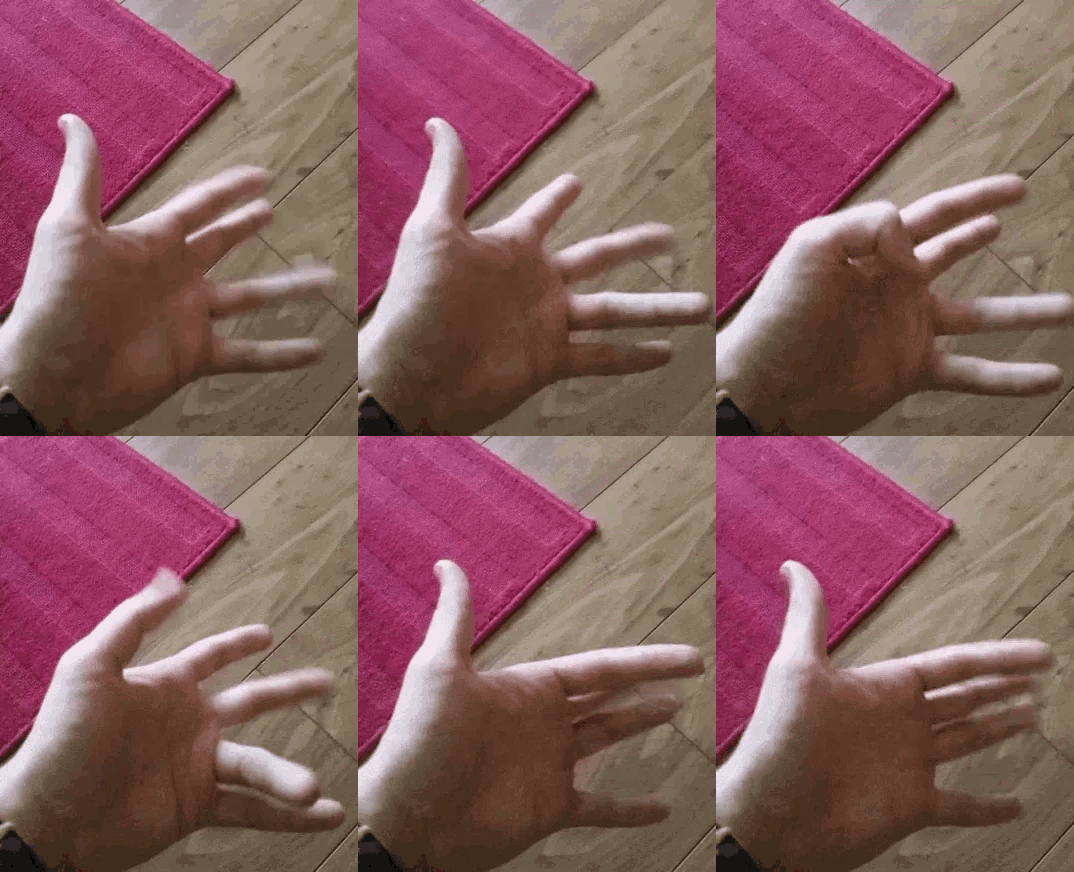
On the flip side, showing up with empty hands can be a sign of good faith. Whenever you wave at a passing car, you are showing whoever’s in the car that you aren’t carrying a weapon.
Whenever you shake hands, you’re letting the other person feel your bare, unarmed palm—though there’s no definitive proof that either of these rituals began as a show of empty-handedness, it’s easy to see how they show a degree of vulnerability and trust.
Instead of showing up without bringing anything good, you’ve shown up without bringing anything bad.
Showing up empty-handed to a martial arts class is a very good idea, generally speaking. There are classes that use specific weapons for training, but the overwhelming majority of classes are unarmed, and if you try to conceal a weapon and bring it onto the mat, everyone hopes you are not invited back to that club or school.
Karate in particular has a place in today’s essay: it literally means the empty hand. The urban legend (or the dojo legend, maybe) says that peasants learned this art in order to defend themselves from the rogue, bullying samurai. Since the peasants were unarmed, so the story goes, they called the art “the empty hand”—karate.
Maybe there is some truth to this story of peasants learning this art to defend themselves against their powerful overlords. This certainly got a lot of kids and young adults to sign up for karate classes during the 80s in the US, although The Karate Kid and Kung Fu helped a ton.
What’s undeniably true is that the art used to be called 唐手, which means Chinese hand. If you’ve never heard this part of the story, you can thank the rise in Japanese nationalism during the turn of the 20th century. By 1905, “empty hand”—空手— had begun to appear in print, and by the 1930s references to China had been erased from karate’s standard name, right as Imperial Japan was attempting to utterly subjugate China.
I believe a purchase of tiny hands and a post or 10 of Dinkles using said hands would push your notes influencer status to unheard of heights