
The Broken Cannoli

You probably know Rome’s origin story by now.
Romulus and his twin brother Remus had just been abandoned by the side of the Tiber river. As luck had it, a female wolf happened to be wandering by. Naturally, as one does, she raised the human babies as her own, nursing them on the milk of wolves.
Over time, the two brothers fought about exactly where their new city would be built, each favoring a different hill.
In a moment of anger and frustration, Romulus murdered Remus, a deed that would forever cast a shadow over his legacy—and over the city that followed. Romulus became the sole founder and the first king of the new city, which he named Rome, after himself.
The real origin story of Rome is more nebulous, but there really was a distinct period of monarchy, followed by a republic—to which much of Western law and tradition ultimately pays homage—and, finally, an empire. That empire ultimately split into western and eastern halves, and the western half died around the year 476.
That left the Italian peninsula a politically fragmented cannoli. You know, when the thing breaks apart in your hands, but it’s delicious and you eat it anyway? Well, Italia (as the Romans had called it) was that delicious broken pastry, with plenty of sweet opportunities available for trade.
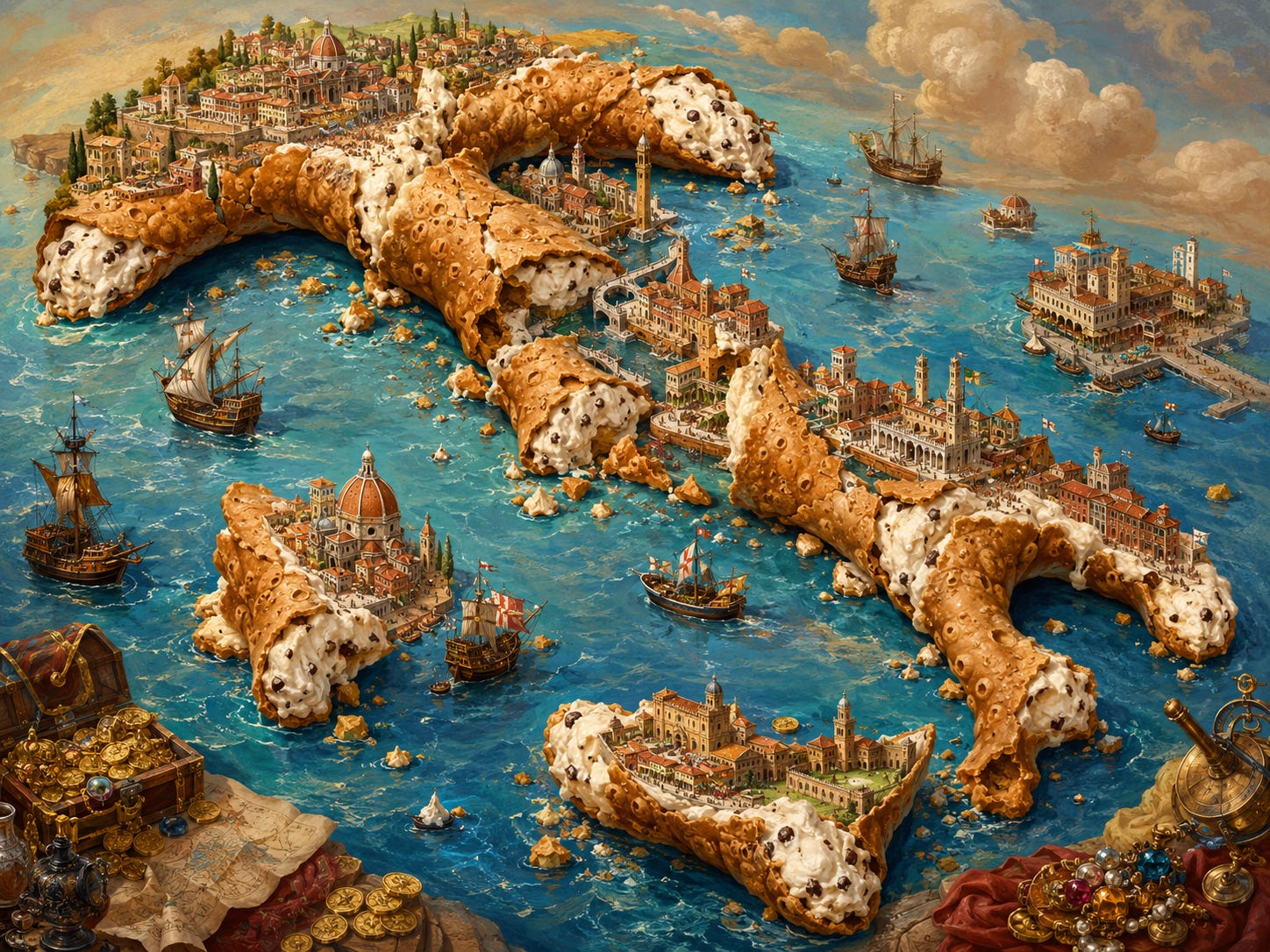
Trade meant prosperity for the ambitious merchants who were eager to tap into international markets, or at least what passed for international markets prior to colonialism and the Age of Exploration. It was Italy’s fragmentation, without a strong monarchy at its core, that opened the door for what came next.
Instead of leaders who claimed to have been given their right to rule by the gods, it was the most successful traders and merchants who set the terms for the cities they came to run.
This meant ruthlessness and efficiency, of course—no power vacuum is ever filled without sharpened elbows—but it also meant a very educated and technocratic elite began running things from their respective broken cannoli pieces. Even a crumb could mean fabulous wealth, but those who controlled the bigger shards began to rival some of those monarchs I mentioned earlier.
We’re talking Florence, Venice, Genoa… these city-states, as they came to be known, would come to create modern commerce, banking, and accounting. They would help usher the Black Death into Europe and hold enormous political and cultural power. They would become kings and popes in their own rights.
All thanks to the broken cannoli.
Synchronicity is at work! My sister gave me a tray of cannoli yesterday!