
The Final Frontier

The word frontier in the medieval European world described the narrow border region between two rival territories. You’d need to constantly keep troops at the front of this zone.
American settlers changed what this meant. Throughout the course of the 1800s, the frontier came to mean the edge of the area where western civilization dominated. Beyond this line, it wasn’t considered safe for white people. Beyond this line was the unknown.
The word frontier gradually became a metaphor for the unknown in any area. There was now a frontier of discovery.
This prominent metaphor was on the mind of Samuel Peeples as he wrote the lines eventually used in the opening credits of Star Trek. Creator Gene Roddenberry must have shuddered when he heard the lines read aloud for the first time:
Space. The final frontier. These are the voyages of the Starship Enterprise.
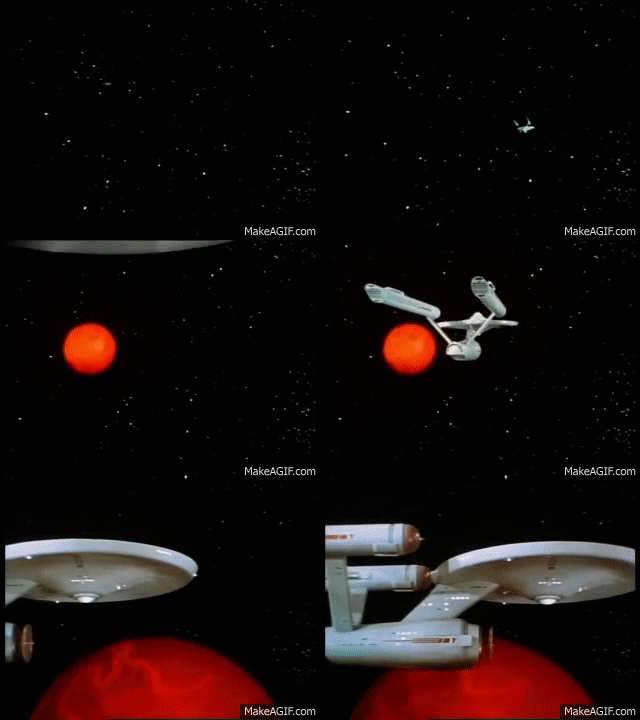
By this time, the frontier language was already being used by NASA to hype the public about space flight. Here I am in 2025, using the frontier metaphor to describe my recent work flow:
As I look back on my life, I see that the things I’ve done the best have always been at this frontier. Nobody else had solved the problem I was trying to solve, at least to my satisfaction, so I gave it a shot. This DIY spirit still lives in the vehicle of my mind, but it has gotten into the driver’s seat recently.
The metaphor for discovery is clear, but there’s also a physical frontier that James T Kirk refers to in his iconic opening. We’re talking about space itself, which seems kind of odd to refer to as a frontier, since we’re already sort of in it.
What’s really meant by space in this context isn’t the framework of the universe that we all share, but instead the area beyond our planet’s atmosphere.
Well, there you go! The final frontier is just a little outside of our atmosphere. Easy peasy, we know exactly where space begins and our planet ends.
Or do we?
I’ve heard our atmosphere referred to by Neil deGrasse Tyson as like the skin of an apple. That’s because it really is that thin as compared to the Earth, but I want to caution you against imagining that the atmosphere is watertight like the skin of an apple.
It’s not even airtight. Actually, it’s not even spacetight.
Every second, trillions of trillions of hydrogen atoms are leaking out into space. This all adds up to hundreds of tons of gas escaping every day. You might start to wonder where the atmosphere really ends if it’s constantly in flux, but also: the frontier has always represented a region in flux.
Even still, there are different ways to describe this particular frontier. The most widely used description of the place where Earth ends and space begins is called the Kármán line—roughly 62 miles (100 km) above the surface.
It’s a practical line for anyone interested in navigating through both our atmosphere and whatever lies beyond. Outside of this region, you’re not flying anymore—you’re orbiting.
Naturally, this isn’t the only attempt to put a boundary on a frontier. The U.S. Astronaut Threshold sits about 50 miles (80 km) above the surface, but instead of a practical boundary based on flight vs orbit conditions, this is more of a relic from an age where we just needed to pick a number.
Another attempt is called the Exobase, and it’s much further out—between 500 and 1000 km above the surface of the Earth. An astute reader will notice that it’s also between two numbers, so it’s a range instead of apple-skin this time. That’s much closer to our earlier idea of a frontier.
Out here, gas molecules very rarely collide. Beneath this zone, our atmosphere behaves like a fluid. Outside of it, there’s no resistance to movement to speak of.
Then there’s the Magnetopause. Our planet is protected by an electromagnetic shield that keeps most of the deadly radiation from our Sun from blasting us all the time. This shield extends outside of the planet by something like 37,000 miles (60,000 km), so it’s not at all like the skin of an apple in terms of how thick it is.
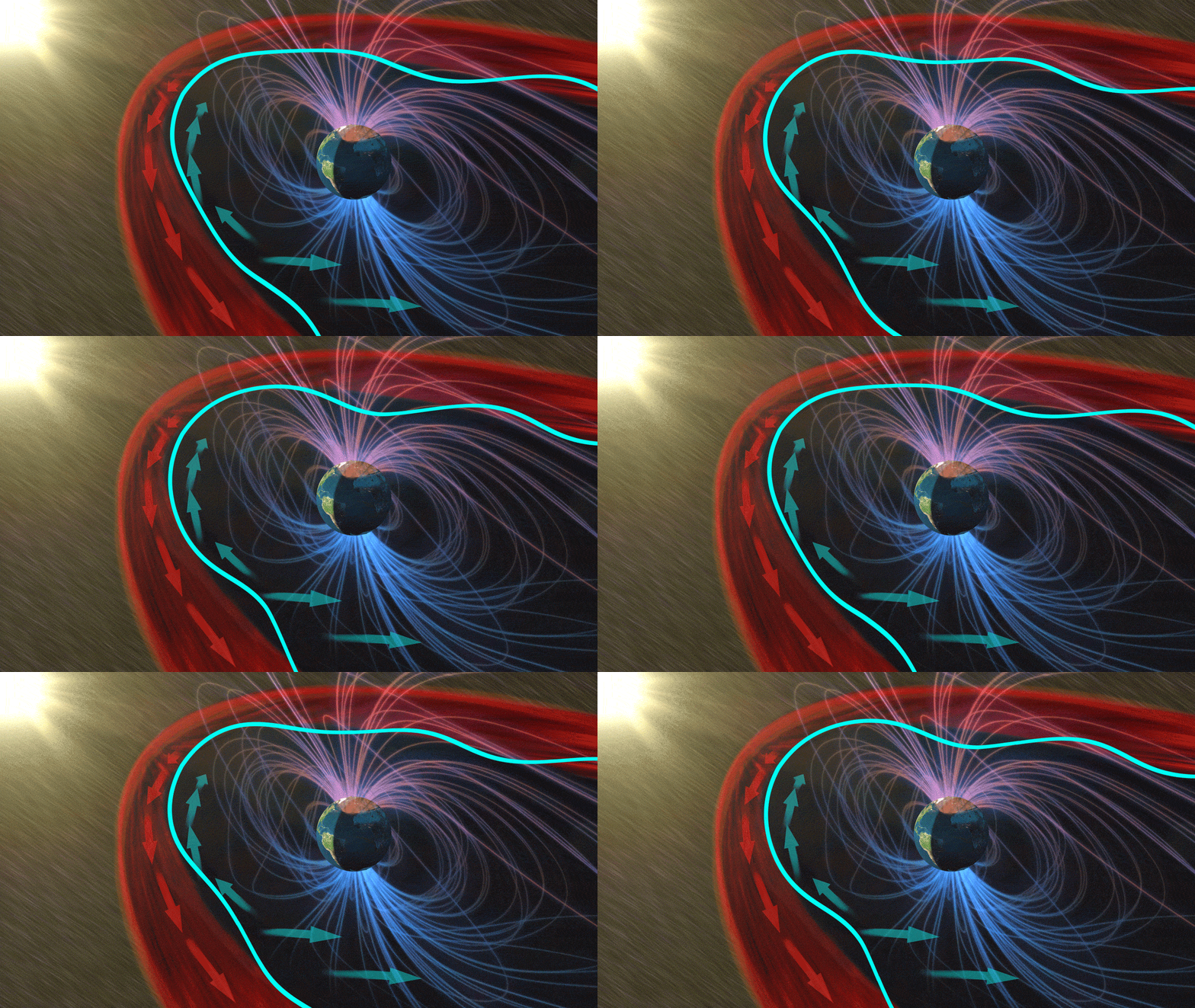
Finally, there’s the Hill Sphere. All the way out here, about 930,000 miles (1.5 million km), Earth’s gravity no longer dominates the constant pull of the much, much bigger Sun.
None of these descriptions of the frontier between Earth and space is completely satisfying, but I certainly understand why all these different ones exist. Frontiers aren’t always description-friendly in the first place, since the people at the frontier are doing things for the very first time. Still, having some way to describe what’s out there and what’s in here is incredibly useful.
It helps me to consider that these processes have been ongoing for millions of years and are likely to continue for millions more.
This is the sort of stuff that I love learning about, but it also frightens me because I don’t understand some of the words. Thanks for keeping it on a level that doesn’t make me want to run.