

During the late 1700s, ideas about human freedom were all the rage. The American Revolution was taking place, and the French were about to follow suit. It was the Enlightenment.
At the same time that technology and scientific knowledge had empowered those at the bottom of the social hierarchy to question those at the top, it had also given those at the top new ways to keep control. “Why should kings control us?” was the question, and “Because we can” was the answer.
Samuel Bentham was an ambitious young engineer who moved to Russia in 1780. He ended up working for Prince Grigory Potemkin, Catherine the Great’s favorite boyfriend, and a powerful administrator. This role came with a lot of resources, especially manpower. This was good, but it presented Bentham with a challenge: supervising so many unskilled workers all at once.
Samuel’s idea was to construct a factory where one supervisor could oversee an enormous number of workers all at once. They’d need to be in the middle, not at one end of a long line. This idea was called the central inspection principle.
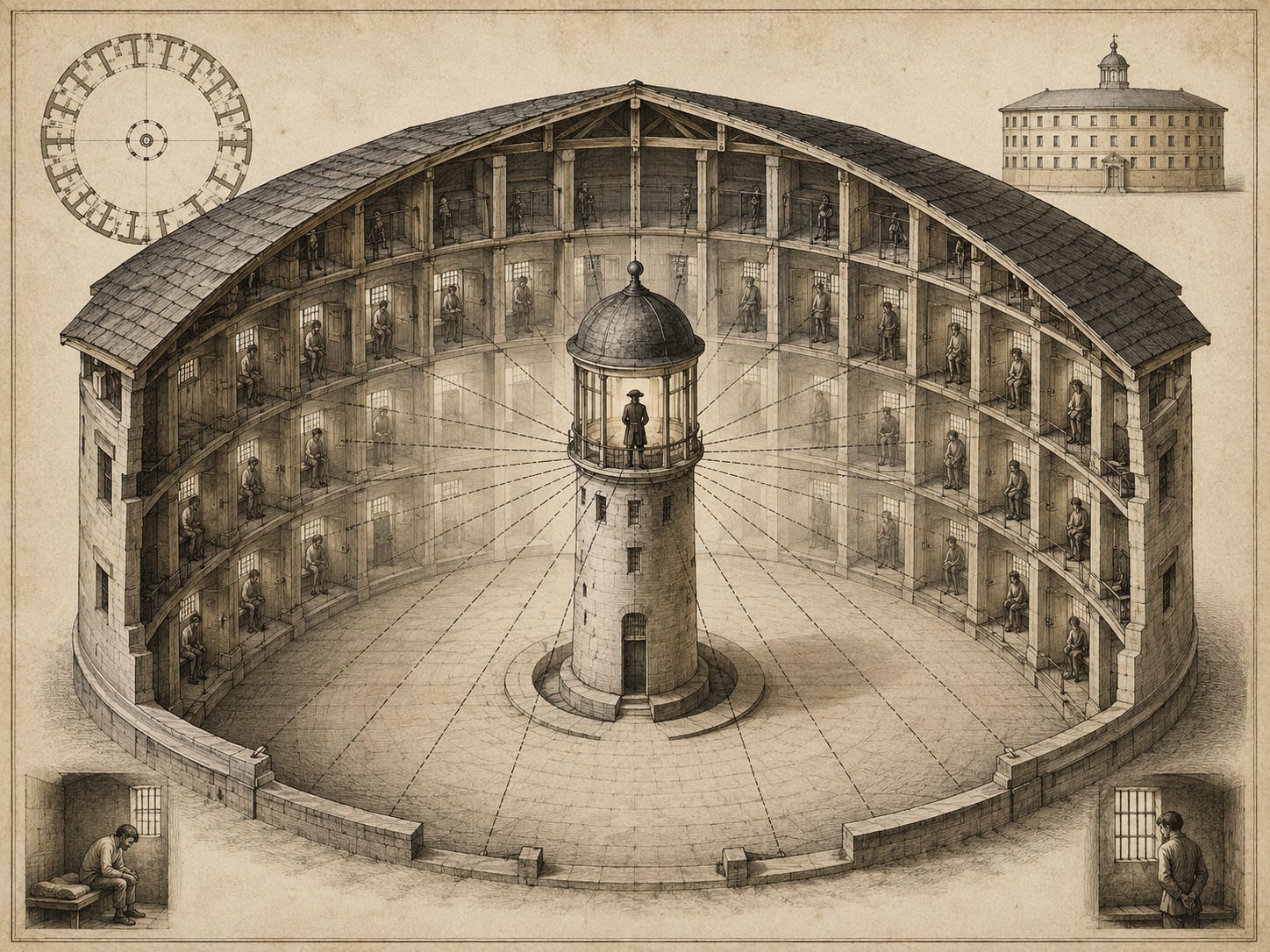
Samuel’s brother, Jeremy, had a lot of his own ideas. He was an Enlightenment reformer, through and through. The potential for more efficient systems constantly swirled around in his mind, and when he visited Samuel in Russia, he was enraptured by this idea of central inspection.
Here’s where the story gets… weird?
Jeremy’s big idea for social reform was to use this central principle for a prison. He reasoned that one guard could stay in the middle, with hundreds of prisoners all around him. None of them would know if he was watching them, so they’d all need to behave.
There’s something to be said for a deterrent like this. You never know if you’ll get away with misbehavior, so you’re disincentivized to misbehave.
Of course, an individual human being has limitations. You can’t really watch hundreds of people at once. Sure, centralized panopticon-lite setups happened, but one person simply didn’t have the ability to observe and control the behavior of hundreds.
At least not until the 2020s.
Now, you don’t have one person sitting in the middle of a warehouse somewhere—you have them anywhere with a fast web connection. This panopticon guard is all alone, but not without tools to help them do the job.
Instead of dozens or hundreds, maybe one person could control thousands. And hey, why stop at thousands?
When Jeremy Bentham died, he instructed that his corpse be unburied and fully preserved so that it could be observed by medical students....
You about to lay waste to some flock cams?