
The Great Bowel Shift

What’s a bowel?
The word itself comes from Latin, where botulus meant sausage. Botellus is the diminutive form, so it meant tiny sausage—but it also came to mean intestines, which really do look like sausages. Old French transformed the word into boele, which English slightly twisted into bowel.
Surgeons have been rearranging sausages—er, guts—for the better part of two centuries now. In 1826, French surgeon Antoine Lembert developed a new technique for suturing severed sections of small intestine back together, and a surgeon used the technique successfully in 1836. This significant milestone gave other doctors the courage to attempt other reconnections or even redirections.
By 1881, Austrian surgeon Anton Wölfler had successfully connected a patient’s stomach directly to their jejunum, bypassing the obstructed gastric outlet entirely. Sewing gut sausages back together would become increasingly common over the next century.
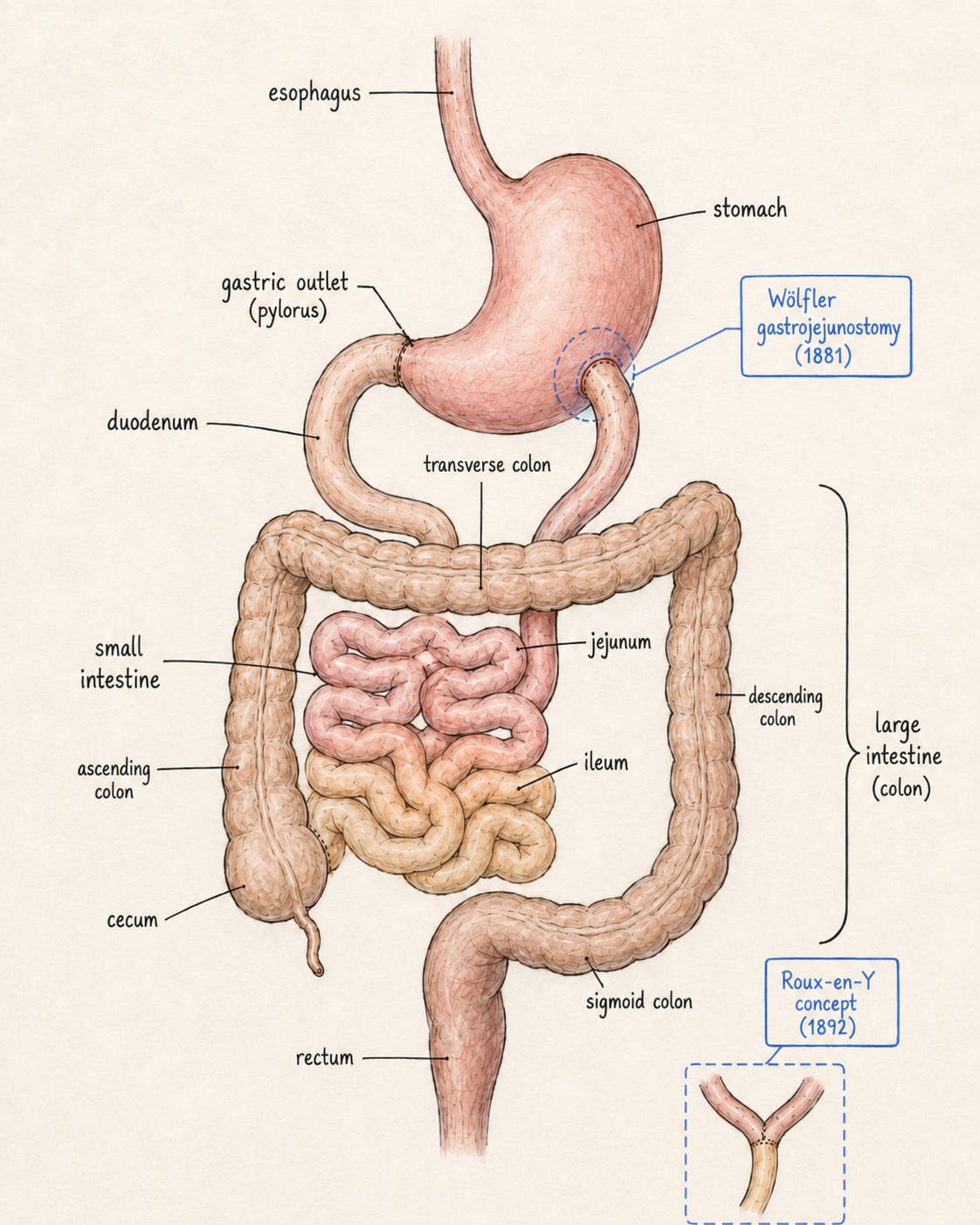
In 1892, Swiss surgeon César Roux developed a procedure wherein he created a Y-shape to reroute food out of the stomach through the jejunum. This is the granddaddy of gastric bypass surgery, though Roux was treating an obstruction and not trying to deal with obesity or help a patient lose weight.
The stage was now set for someone to push forward a bold idea: surgery could be used to help you lose weight. In 1954, one of the first operations deliberately designed for weight loss took place. The upper small intestine was connected to a point much farther downstream, bypassing most of the small intestine—and allowing the body to absorb fewer calories.
Gastric bypass surgery followed in the late 1960s, where the stomach is made into a small pouch and connected to the small intestine from there—once again, at the jejunum. Stomach stapling would follow, and laparoscopic bypass surgery in the 1990s opened up an entirely new field.
For the last couple hundred years, we’ve been figuring out how to shift our bowels around.
Spell it with two L's and it's a person's last name. Sir Mackenzie Bowell was briefly Prime Minister of Canada in the 1890s.