The Mother of All Demos
Or MOAD, For Short
The crowd gathered in a darkened conference room, anticipating another predictable presentation on a boring overhead projector.
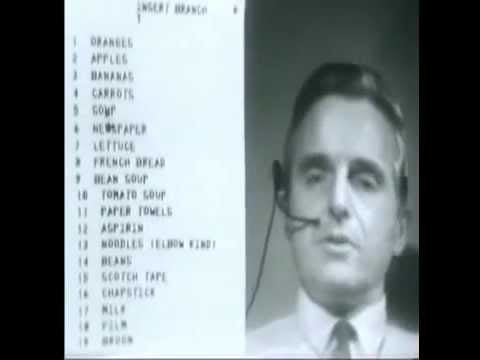
Instead, what they witnessed was nothing short of revolutionary, leaving the audience stunned. They watched as characters—letters and numbers—appeared on a screen and then were deleted and manipulated in a way imaginable only in a science fiction book, graphic manipulation, and the control of an on-screen pointer using a curious device the presenter called a “mouse.”
Then, the audience saw something perhaps even more revolutionary: they watched as two computer users who were across the country from one another used a "networked information system" that allowed them to see a shared “Google Doc” in a primitive form of todays Internet.
Growing up Gen X, I remember the advent of the World Wide Web well. I was first exposed to chatrooms and the larger web in 1994, and quickly came to learn about Tim Berners-Lee’s 1989 hypertext and 1990’s publication of the first website ever.
That’s why it shocked me to the core to discover the Mother of All Demos, described above. It didn’t shock me because of what was shown, but instead because this demo took place in 1968.
1968!
That’s before we landed on the moon, and well before I was born.
Douglas Engelbart
In 1968, the world was in the grip of a technological revolution. The space race was in full swing, television was becoming a fixture in every household, and mainframe computers—massive, room-filling machines—were becoming more commonplace in businesses and academic institutions. Yet, the concept of personal computing was still a distant dream, and the Internet as we know it was little more than a futuristic concept, barely more than a whisper in the minds of a few far-thinking individuals.
One of those far-thinking individuals was Douglas Engelbart. Born in 1925, Engelbart was a visionary technologist who dreamed of using computers as tools to augment human intellect, a concept he termed "bootstrapping."
His ideas were considered radical for the time. Instead of viewing computers merely as machines for computation, Engelbart believed they could be used to enhance human capabilities and facilitate collaboration on a massive scale.
Engelbart began his career as an electrical engineer at NACA (the precursor to NASA) before earning his Ph.D. in electrical engineering and computer science from the University of California, Berkeley, in 1955. In 1963, he established the Augmentation Research Center (ARC) at Stanford Research Institute (SRI), where he started working on his vision of interactive computing.
The year 1968 found Engelbart on the cusp of unveiling his revolutionary ideas to the world. As the date of the Fall Joint Computer Conference in San Francisco drew closer, Engelbart and his team prepared to give a demonstration that would drastically change the way people perceived computers and their potential role in society.
Yet, no one in that conference room, not even the most optimistic attendees, could have anticipated the magnitude of what was about to unfold. As they settled into their seats, they were on the precipice of a revelation—about to witness the birth of a digital age that continues to shape our world today.
The Mother of All Demos
On December 9, 1968, during the Fall Joint Computer Conference in San Francisco, Engelbart and his team demonstrated their ongoing work at the Augmentation Research Center. The event was later to be known as "the Mother Of All Demos", or MOAD for short.
Engelbart showcased the oN-Line System (NLS), an early computer system they had developed that was one of the first to use a graphical user interface, hypertext linking, and a command-line interface.
Imagine the awe of those present as they saw a computer mouse for the first time, a device that Engelbart used to control an on-screen cursor smoothly. He explained (and demonstrated) how the "mouse" could select text, draw, and execute commands. Today we take these functions for granted, but at that time, it was like witnessing magic.
Engelbart didn't stop there. He proceeded to demonstrate real-time editing and formatting of on-screen text, showing how sections could be cut, copied, and pasted, or even moved around. The demonstration included collaborative editing, with Engelbart in San Francisco and his colleague Bill Paxton in Menlo Park working simultaneously on the same document—a precursor to the cloud collaboration tools like Google Docs that we use today.
But perhaps the most astounding part of the demo was when Engelbart showed off a precursor to what we now know as the World Wide Web. He clicked on certain words or phrases, which would then link to other related documents or even different sections of the same document. This concept of hypertext was revolutionary, as it promised a new way of organizing and accessing information, breaking away from the linear structure of traditional text.
To put it in perspective, the technology that Engelbart demonstrated in 1968 wouldn't become mainstream for another two to three decades. At a time when most computers were still interacting with punch cards and printed output, the Mother of All Demos offered a glimpse into a future where computers were interactive, user-friendly tools designed to augment human capabilities, a future that we are living today.
The Impact and Legacy of the Mother of All Demos
The "Mother of All Demos" did not immediately transform the world of computing overnight. Remember, I first came across the Web in 1994, and the first time I used a mouse was probably some time in the early 80s. Using a computer when I was a kid meant knowing some code, period.
What Engelbart did with the MOAD served as a guiding beacon for what could be achieved, a kind of north star for the industry. The vision presented by Engelbart influenced a generation of technologists and engineers who would go on to develop the personal computer and the Internet as we know them today.
While it took until the early 80s for me to encounter my first mouse, within a few years they were ubiquitous: you couldn’t find a computer without one.
Similarly, the hypertext system, a precursor to the World Wide Web, had to wait until Tim Berners-Lee took the idea and ran with it in 1989. Today, hypertext is so ubiquitous in our digital lives that it's hard to imagine a time when it didn't exist, but at the same time, it’s easy for me to remember growing up without its pervasive presence.
Engelbart's greatest legacy might be in his vision of computing as a collaborative tool to augment human intellect. Steve Jobs picked up the ball and ran with it, calling the computer “the bicycle for the mind.” Jobs went on to give a few demos himself, from what the kids tell me.
Today, we see this vision realized in the plethora of collaborative tools available, not only by way of human interactive tools like Dropbox, Google Docs, online chat, and so on, but also by way of human and LLM interactions that are now taking center stage, as the “personal assistant” aspect of AI is beginning to be realized.
Engelbart's philosophy of "bootstrapping"—improving tools and processes in a way that amplifies human capability—is more relevant than ever in today's world. From machine learning algorithms that can learn and improve over time to innovative approaches to problem-solving like Design Thinking, we see Engelbart's influence in how we approach technology as a tool to augment our abilities and solve complex problems.
The technologies that Engelbart demonstrated in 1968 have since become commonplace, so much so that we often take them for granted. Yet, it's important to remember that these technologies were once revolutionary ideas that required great vision, perseverance, and ingenuity to bring to life.
The "Mother of All Demos" serves as a reminder of what's possible when we dare to dream and push the boundaries of what's possible with technology. It stands as a testament to the power of vision and innovation, a lesson that continues to inspire technologists and innovators today.
Gradually, then Suddenly
While we can never fully predict the future of technology, looking back at Engelbart's groundbreaking demonstration, we are reminded that our current technological landscape was once a distant dream, and it spurs us to imagine what the next few decades might bring. We owe much of our digital age to Engelbart's remarkable vision, and it's exciting to consider where his legacy will take us in the future.
Some of this stuff takes a long, long time to arrive. Nothing conveys this message better than the MOAD. A demo from 1968 of products that came out 15 and 25 years later is mind-blowing, but that’s how this often goes: gradually, then suddenly, as I wrote about here:
Gradually, then Suddenly
In Ernest Hemingway's 1926 novel "The Sun Also Rises", there's an exchange that encapsulates the sometimes deceptive nature of change: “How did you go bankrupt?” Bill asked. “Two ways,” Mike said. “Gradually and then suddenly.” A century later, this phrase has never been more relevant. Leave it to Hemingway!
Engelbart's vision didn't come to fruition overnight, but the seeds he planted have grown into the technological forest we navigate today. His legacy serves as a powerful reminder that the path to innovation is often gradual, yet the impact can be sudden and profound.


