
The World Is At Your Command

The amount of things we humans can do has exploded over the course of my lifetime. When I was born, there wasn’t email or text messaging, and social media was off in the distant future. Today, I can prompt an AI model to create a slideshow with PowerPoint, a program I’ve never used myself.
I’ve written a bit about how truly brilliant technology is, as Clarke perfectly put it, indistinguishable from magic.
In fantasy stories and myths, magicians often cast spells by speaking incantations or performing intricate hand gestures. In our modern world, technology is rapidly evolving to the point where we, too, can control our surroundings with just our voices and movements.
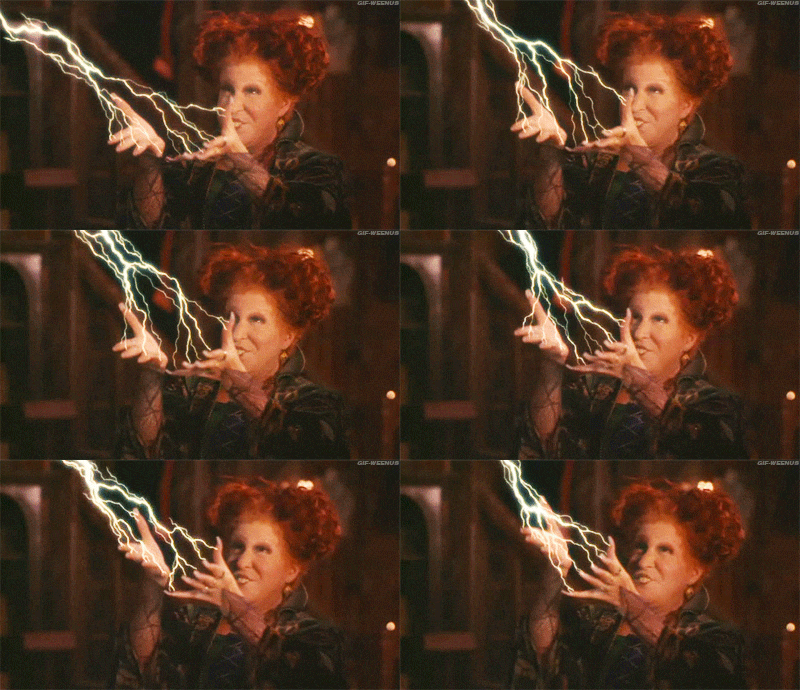
With all this magic around us, you might think we humans would be pretty content. After all, we can now do things we never imagined possible, and the list of things we’re able to do keeps growing ever faster.
One particularly overused quote comes to mind here:
Be careful what you wish for, lest it come true.
This is Aesop writing around 600 BCE, ultimately reinforcing the Beatles, who recorded the song Nowhere Man in November of 1965. The mid-60s brought a lot of convenience into the lives of middle class people, but there was also tremendous turmoil in the world. Vietnam wasn’t yet the pressure cooker it would become, but the civil rights movement in the US had already caused a violent backlash from the deep south.
While all this was going on, John Lennon wrote about having the entire world at your command, but making nowhere plans for nobody.
Today, we have even more at our command, but are we making nowhere plans?
Doesn’t have a point of view
Knows not where he’s going to
Isn’t he a bit like you and me?
I think he’s more than a bit like 2026.
When you’re given superabundance, you tend to saturate your happiness pretty quickly. What I mean is that if you have one restaurant in your town and they have a special dish you like, you’ll get excited about going there for that one night. Now, imagine you have a hundred different restaurants, all a short walk or drive away. There’s Thai food, Indian, pizza, Mexican, poke—you name it.
You can probably see where this is going: after a few months of this experience, you start spending ever-more time debating which restaurant to go to, and it becomes almost like an important part of the meal. I don’t really want Thai food this week, you think, so let me see if they have something new or interesting.
This is exactly the sort of first-world problem we have today. Instead of choosing between superabundant restaurants, we are choosing how to spend our time.
I’m reminded of art projects I had in school that limited our scope. We were told to do something with monochromatic elements, or to draw something emphasizing negative space. This would be freshman and sophomore years, mainly.
By the junior and senior years of art school, the idea was to just paint or draw whatever you wanted. You’d build your own little thesis, and just go.
All this freedom sounds incredible, but a funny thing happened: some of the best outputs were in those constrained settings, where you had to carefully consider what to do and how to be clever. Contrast that with having all the art supplies and freedom you could imagine, where you nonintuitively end up with something worse (at least some of the time).
The world is at your command, but only if you choose to command it.
I read most of your essays. This is probably my favorite. You are always a thoughtful writer.
I really believe constraints and creativity go hand in hand.
"Write anything" is much less of a nudge than "Write a cursing rap verse about a cat stealing paperclips from the office supply room."
That's most creative writing classes have specific writing prompts, etc.
I find this with prompting AI models, too. The more interesting constraints you give them, the further you push them outside the comfort of their training data and away from generic, boring outputs.