
We Are Giants

Look at you! You’re really, really big, aren’t you?
I don’t mean that as a slight—I mean it as a perspective shift. We are all giants.
I mean, we’re giants when you consider what happens inside our bodies. We have entire civilizations of bacteria and vast landscapes of cellular structures.

Take your gut. Inside it is an enormous nation of bacteria, all working in tandem with your own cells, and in equal or greater numbers (still up for debate).
Those tiny, friendly warriors instantly go to battle on the chyme, slurping away any remaining nutrients and water. These critters… well, there is no delicate way to say this: they eat your poop, and then you poop them out.
Poop is largely a structured bacteria pile, in a way.
This particular nation of trillions exports poop to the world, but it’s definitely a service-based economy; poop is just one of those leftovers.
This is all about red blood cells, those wonderful little oxygen-delivery drones we count by the trillions in our bodies. When these cells die, the hemoglobin inside them breaks down into a yellowish substance called bilirubin.
The liver then turns bilirubin into bile, AKA gall. This process is just one of the many nation-states operating inside you, though. Each of your internal systems has billions of individual component parts, going all the way down to the cellular level, and there are dozens of systems in your body.
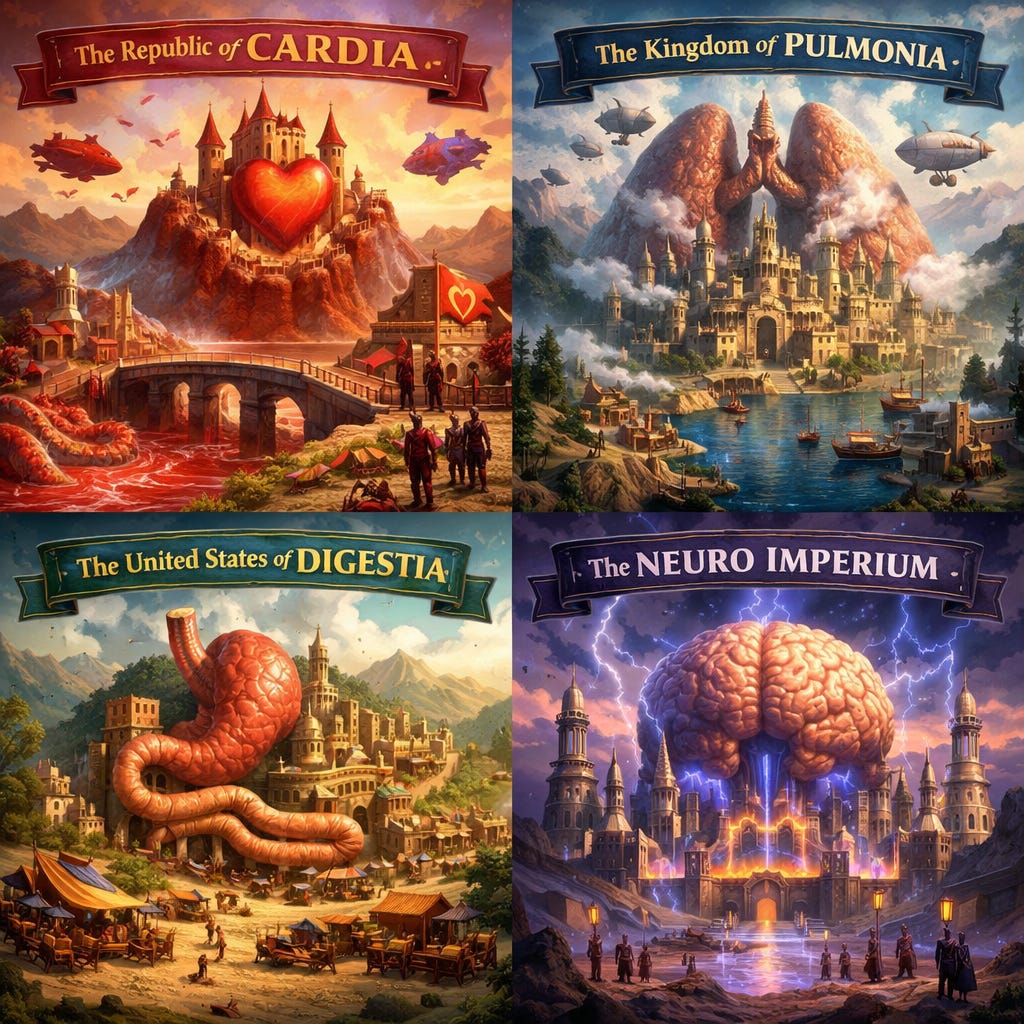
Zooming out from the gut, one system in your body that’s less like a nation-state and more like the internet is your nervous system. Your world relies on this communication network to coordinate movement, react, and think.
Your skin is a lot like our atmosphere, keeping the most harmful things from just waltzing right in, acting as a first line of defense. Your atmosphere, like the one that surrounds the Earth, also acts as climate control, so your skin helps to keep you warm or cool under adverse circumstances.
Your kidneys handle water filtration throughout your entire world, and your lymphatic system handles all the drainage. And your gut is an entire nation of workers, processing food for the entire planet, like the energy sector generating more offshore wind.
This is getting very Feynmanesque, isn’t it? You’re not a human-sized body, but instead an entire world with adventure waiting for an imaginary tiny explorer.
Feynman’s seminal lecture There’s Plenty of Room at the Bottom used this idea—of reframing the relative size of the human body—to present the case that we should try to build smaller and smaller things. Here’s my brief follow-up essay, There’s Plenty More Room at the Bottom:
Imagine building a tiny machine, so small you can barely see it with your naked eye. This machine is designed to build other, smaller machines.
The smaller machines are tiny enough to be invisible to the naked eye, but their job is to build machines that are smaller still.
You get down to the point where microscopic submarines are navigating your bloodstream, patrolling for potential predators. They can even prevent molecules from getting into the wrong place, and even tinier machines are capable of manipulating atoms themselves.
I’ve tried my best to preserve this sense of wonder Feynman shared so enthusiastically with us, and I owe a tremendous debt to his imagination. I hope you get a sense to share it for just a moment today, too.
Might this have something to do with the micro manifesting itself in the macro?
What gets me is how Feynman used scale shifts not just as a cool thought experiment but as an actual roadmap for nanotechnology. The idea that miniaturization wasnt just about making things smaller but about accessing entirely new physical phenomena at diffrent scales is still playing out today. Ive been following some of the recent work on synthetic biology and it really does feel like were building those microscopic machines he imagined, though its happening through wetware more than hardware.