
Garry Against the Machine

Garry’s first time against the machine went as expected.
This was IBM’s Deep Blue, a new computer chess program that would finally challenge the very best humans in the world. It was 1996.
Garry was Kasparov, widely considered at the time the greatest ever to play the game. Garry had been ranked #1 in the world for 255 months total, a fantastic run that spanned all the way from 1984 until 2005. He was also ranked higher than anyone ever to play the game up until that point.
This would be a different type of contest—of mind against machine—though the idea of a machine that could beat a human at chess was nothing new. In fact, it was already two centuries old by the time of Deep Blue.
This was the Turk, an elaborate automation that could win at chess against some of the best players in the world. Imagine how astounding this feat must have seemed two centuries ago, before the industrial revolution had taken hold in Europe, as Napoleon’s soldiers’ buttons were beginning to rot.
Eventually, the Mechanical Turk was outed as a fake, and chess remained the domain of human intelligence. By the mid-90s, though, things were beginning to change.
Still, Kasparov made short work of this computer system, winning by a score of 4-2.
If 1996’s contest was against Deep Blue, observers later joked that 1997 was Deeper Blue. It was similar to last year’s system, but some notable upgrades had since taken place.
In this second round of Garry Against the Machine, things went differently.
Garry won the first game without much incident, but in the middle of game 2, Deep Blue made a move that seemed very non-machine like to Kasparov and to other observers. After some back-and-forth where IBM denied any human involvement, the contest continued.
Ultimately, the games were tied going into what would be a memorable final. In just 19 moves, Kasparov literally threw up his hands in resignation.
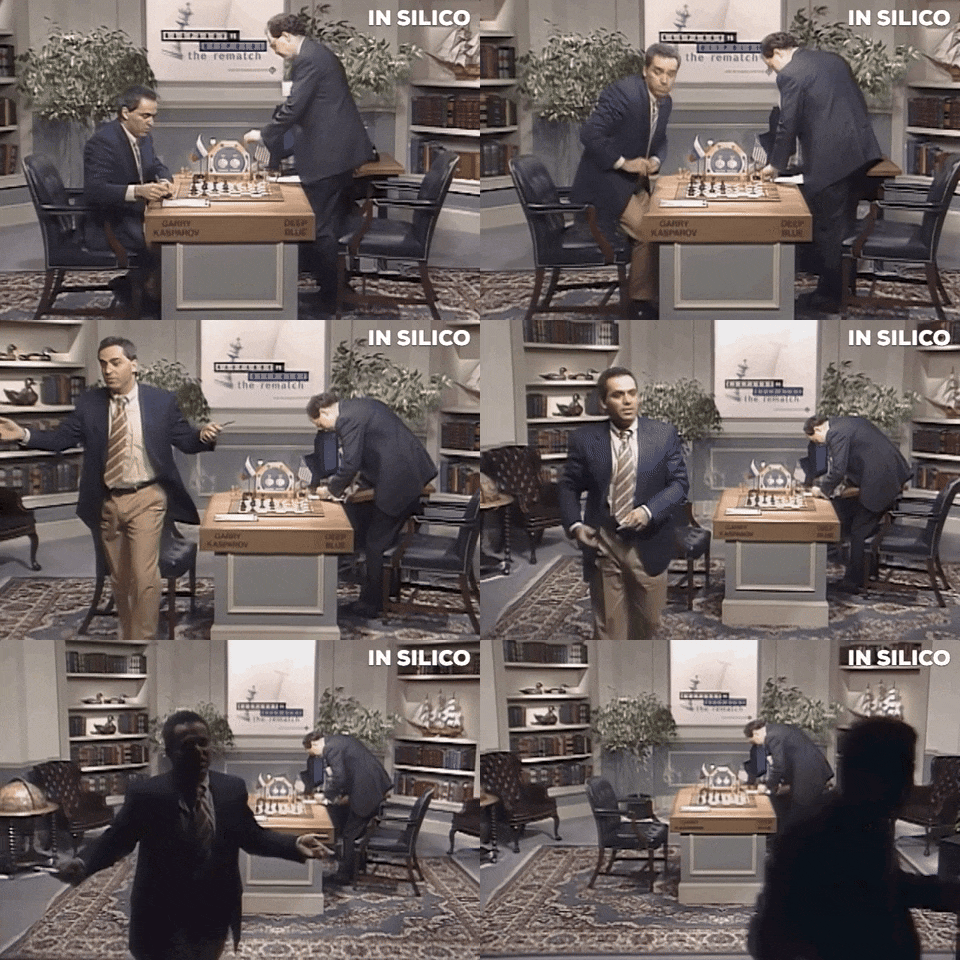
After two of the most notable battles anyone has ever had against machines, you might think Garry would be done going up against the machine. Not so.
First of all, there was always a machine behind the machine. For Kasparov himself, this was the Soviet Union—the nation-state that paid him to be a full-time chess player in the first place. The USSR took great pride in dominating the west in chess for most of its post-WWII existence.
Kasparov was their poster-boy.
The machine behind the machine that was Deep Blue was, of course, IBM.
Now, facing a post-Soviet Russia that had seemingly turned its back on any potential for democracy, Garry faced off against one more machine.
Modern Russia carries the Soviet legacy forward in a lot of ways. The full-scale invasion of Ukraine, the surveillance state, the international criminal spy stuff—Russia in 2026 seems much more like a continuation of Cold-War era practices than any modern nation-state trying to integrate into the wider world.
Today, Garry Kasparov speaks out against this machine, once again battling. This time, he uses his lived experience to warn people that Russia is, indeed, becoming the USSR.
Yeah Garry is one of the most vocal Kremlin critics out there for sure, and rarely hedges his language against them.
It read like a short story, complete with a nifty twist. Loved this!