

During the early 20th century, there weren’t a lot of people who were thinking about rockets. Sure, there were a few science fiction writers who had explored space travel. Jules Verne’s From the Earth to the Moon (published in 1865) seems like a great candidate for a story about rockets, but Verne’s explorers got there by being shot out of an enormous cannon.
Rockets were the stuff of fireworks and warfare, not something you’d want to use to propel yourself forward! The very idea seemed insane, as illustrated by this delightful GIF of JCVD trying to jump in front of an explosion to get somewhere faster.

It took one of those Konstantin Tsiolkovsky types to make rockets real. The type I’m talking about are the Nikola Teslas of the world, those who have no problem living in a world that does not yet exist. Tsiolkovsky’s imagination was paired with a powerful mathematical mind, and he thought space was humanity’s future.
The Tsiolkovsky rocket equation is considered the backbone of modern rocketry, and in 1903, this self-educated schoolteacher showed how a rocket’s velocity depends on the exhaust velocity of its fuel and the ratio of starting mass to final mass.
In order to take advantage of this new understanding, Tsiolkovsky came up with the idea of staging, where an empty fuel tank could be discarded during ascent. This is pretty much how we got into space in the first place, and any rocket that’s going into orbit uses staging today.
Sergei Korolev, the mind behind Sputnik, would later credit Tsiolkovsky’s writing as his key inspiration. The blueprint for how to get into space had been designed and, now, implemented.
On the other side of the oceans, Robert Goddard was also thinking about how rockets could get us into space. In 1919 he published A Method of Reaching Extreme Altitudes, which was completely dismissed by the press as fantastical.
The New York Times even ran an editorial decrying the Moon Man who believed rockets could one day reach the Moon. They retracted it only after the Apollo 11 mission had landed on the Moon.
While Tsiolkovsky was a pen and paper kind of guy, Goddard was a let’s go blow stuff up kind of dude. He was all about experiments, and on March 16th, 1926, his persistence paid off. A liquid fueled rocket blasted 41 feet in the air, and it only stayed up for a couple of seconds, but the world now had the proof it needed.
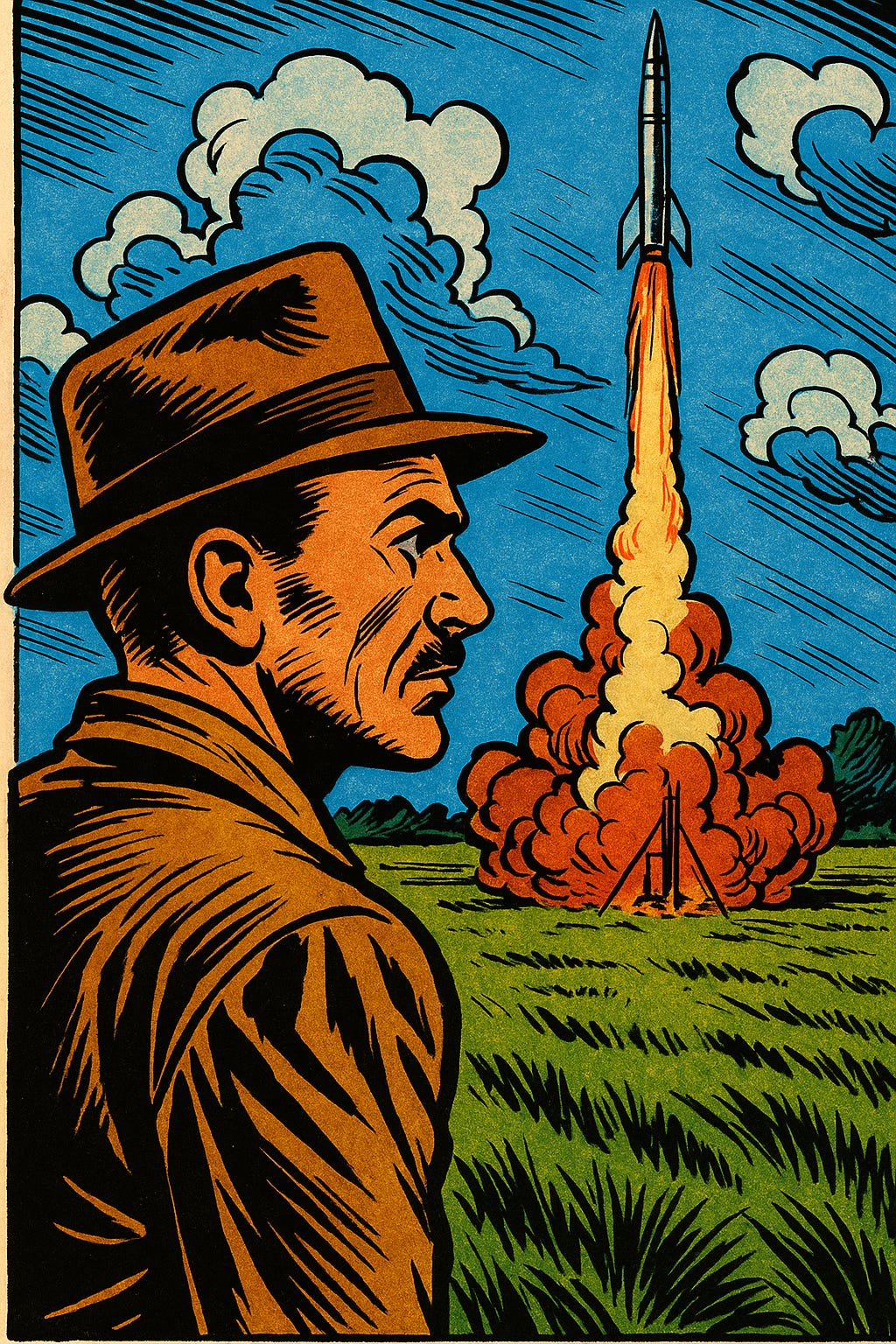
Liquid, staged rockets would eventually get us into space.
If Tsiolkovsky was the theoretician and Goddard was the experimenter, then Wernher von Braun was the engineer. Brain drain during the rise of the Nazis led to many of the most brilliant scientists fleeing Germany, but von Braun was like a crown jewel for the regime, and the Nazis kept him close to the vest.
The V2 showed that rockets could be guided, and von Braun’s team successfully demonstrated this by terrorizing London. After the conclusion of WWII, the US scooped von Braun up and brought him to the US, where he would become NASA’s lead engineer, ultimately becoming the director of the Marshall Space Flight Center in Alabama.
Here, the Saturn V rocket was developed. The Sputnik shock would induce Kennedy to make that famous moonshot speech, and it was this enormous rocket developed by von Braun and his team at NASA that finally got us there.
When people said something wasn’t rocket science, they were thinking of the immensely complex operation von Braun and his team was running. This incredibly meticulous work relied on accurate calculations, leaving little room for error in an environment where everyone was both brilliant and effective.
Von Braun was the Oppenheimer of NASA. He wasn’t a brilliant physicist or talented experimenter, but more like a driving, organizing force who understood what was needed to get things done. Was this rocket science, then?
No, not really. This was precision engineering, thanks to theoreticians and experimenters like Tsiolkovsky and Goddard.
"Jules Verne’s From the Earth to the Moon (published in 1865) seems like a great candidate for a story about rockets, but Verne’s explorers got there by being shot out of an enormous cannon."
The explorers were Americans, affiliated with the Baltimore Gun Club and led by one Impey Barbicane. Verne knew even then what country would take it to space first.
It's not prompt engineering, I'll tell you that much.