
Opposite Day

Growing up in the 80s, we did a lot of things to amuse ourselves that didn’t involve the internet. I’ve talked a bit about passing time on a road trip during this era. Besides primitive handheld electronic games, games of the mind dominated these trips.
20 Questions is still one of my all-time favorites. It demonstrates the power of the binary, and how you can figure out anything just by asking yes or no questions. You can build anything with yes and no as well.
I was always trying to get other kids to play these games, and I remember getting an awful lot of eye-rolls. As a result, I found games I could play all by myself, even if others weren’t really interested in playing them at the moment.
One game like this was called Opposite Day.
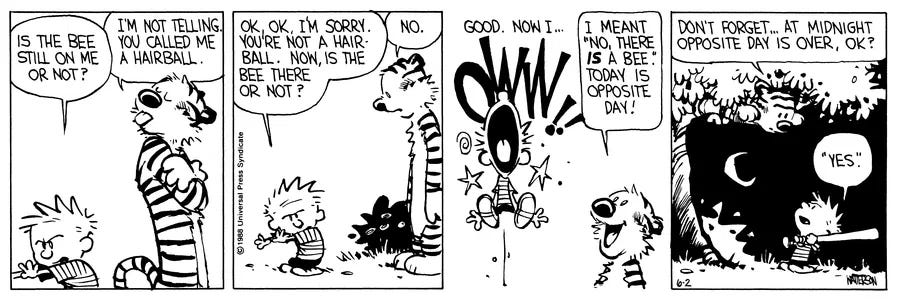
The premise was simple, as illustrated by this fantastic Calvin and Hobbes strip. You have to say the literal opposite of everything, all day.
You’re thinking: this seems impractical. I’m thinking I know where a lot of those eye-rolls came from. Still, as a kid, you can sometimes pull this off—an entire day dedicated to a mind game.
This is one of those games I imagine ancient Greek philosophers like Zeno or Heraclitus would play as teenagers, just to get those eyerolls going. Still, there’s use in the exercise beyond just annoying your parents.
By thinking in opposites all day, what you’re really doing is considering the definition of things. You’re really thinking about what the words you say mean.
It might sound shocking, but we pretty much never do this as a practice. Instead, we take for granted that we know what words mean, along with their context.
I mean, we do this until we find the right etymological rabbit hole.
We would play a game to find things that start with the letters in-order of the alphabet.
I once spent an entire day not breathing air or consuming any food or fluids. Did you not see nothing that I didn’t do here?