
The 1890 Census

After the Civil War, the US had become a great deal more connected with railroads and telegraphs, so people from different walks of life were in constant contact with one another.
Industry was thriving, and the US economy had just overtaken the UK to become the biggest in the world, and its citizens were on their way to taking the per-capita lead as well.
At the same time, government bureaucracy had grown a great deal. At its core, the so-called war between the states had truly been a war for the survival of the federal government, and the feds had won. Reconstruction in the South had required the continued presence of thousands of US Army troops, federal election oversight, and much more bureaucratic boots on the ground.
The combination of industry changing ways of life, additional bureaucracy, and sudden connectedness meant a great deal of chaos when trying to take account of everything. After all, if you didn’t know what you were dealing with, how could you possibly plan to deal with the thing?
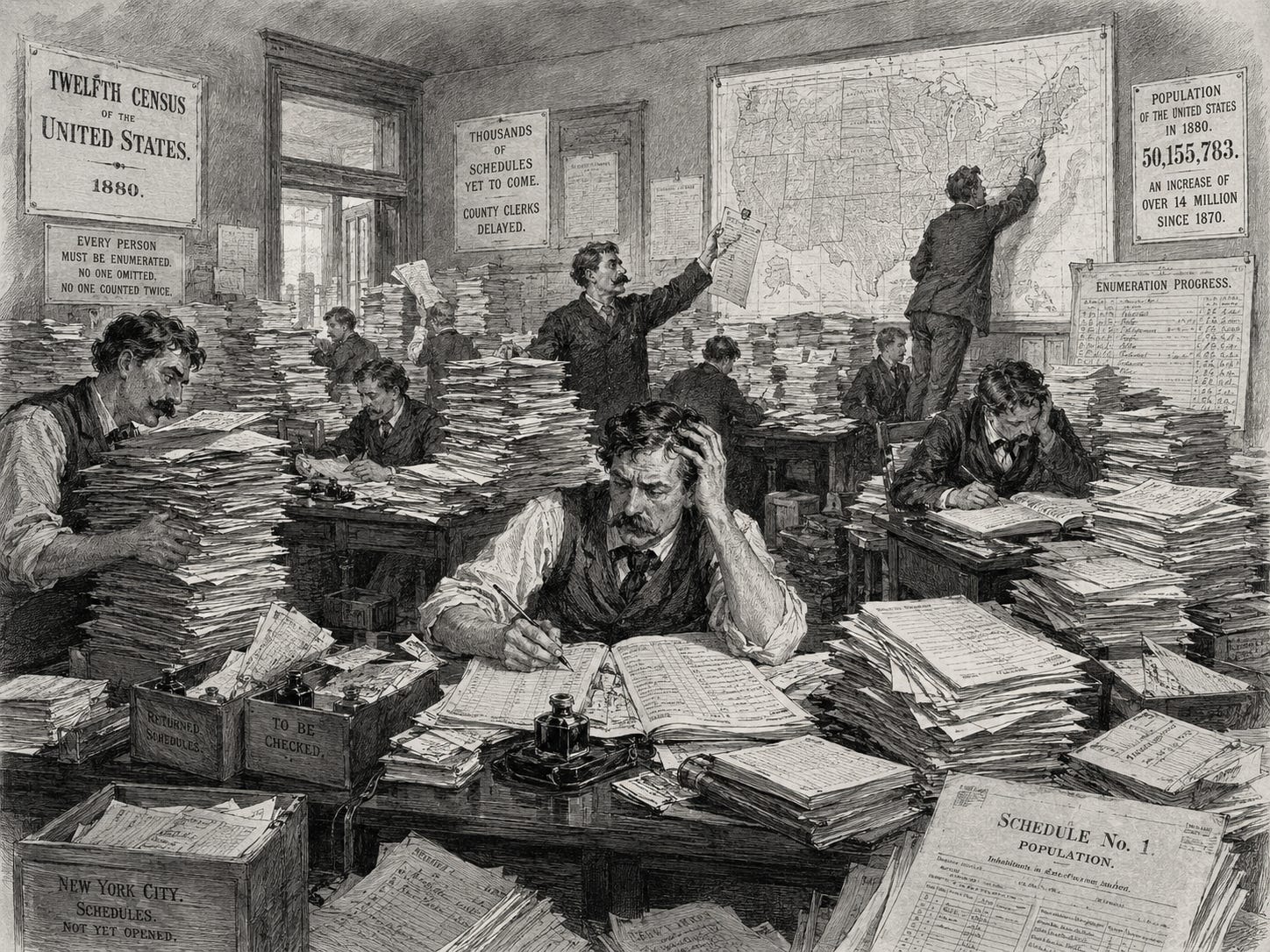
That sets the stage for the 1880 census. The United States felt like a writhing patchwork of different areas, but these areas kept coming into constant contact. The government needed to know more information about the people whose needs they were supposed to serve—and whose wallets they were supposed to tax.
Instead of just counting the people who lived in the United States, the government needed the census to tell them much more. Where and when were they born? What did they do for employment, if anything? How many people lived in this household, and who were the breadwinners?
Connected. Bureaucratic. Industrial.
This was a new nation, very different from previous generations. It was already going to be a challenge to conduct the 1880 census even without massive population growth, but that came too. From 1870 to 1880, the US population grew by over 30%, adding over eleven million people.
Employment history, race, gender, literacy and education level, a personal history of illness… these questions were becoming overwhelming when multiplied by a growing population.
It began to dawn upon census officials that there would barely be enough time to tabulate all this before the next census! Even worse, the map itself was rapidly evolving, as four new western states were added to the union between 1880 and 1890, with two more added in 1890.
Worst of all, at this pace, they wouldn’t even be able to finish the 1890 census before it was time for the 1900 census. The data would be obsolete before it had even been published.
This was deemed utterly unacceptable, so the most American solution ever was proposed: a contest for money.
In 1888, the Census Office (not yet the permanent Census Bureau we have today) held a competition to see who could invent the fastest way to process census data. The information needed to end up in a spreadsheet, basically, and entering this data by hand would just take too damn long.
The winner would receive a lucrative contract to process and tabulate the 1890 census.
A mechanical engineer named Herman Hollerith won by kind of inventing computers. He created an electromechanical machine where a punch card containing holes representing data could be fed in.
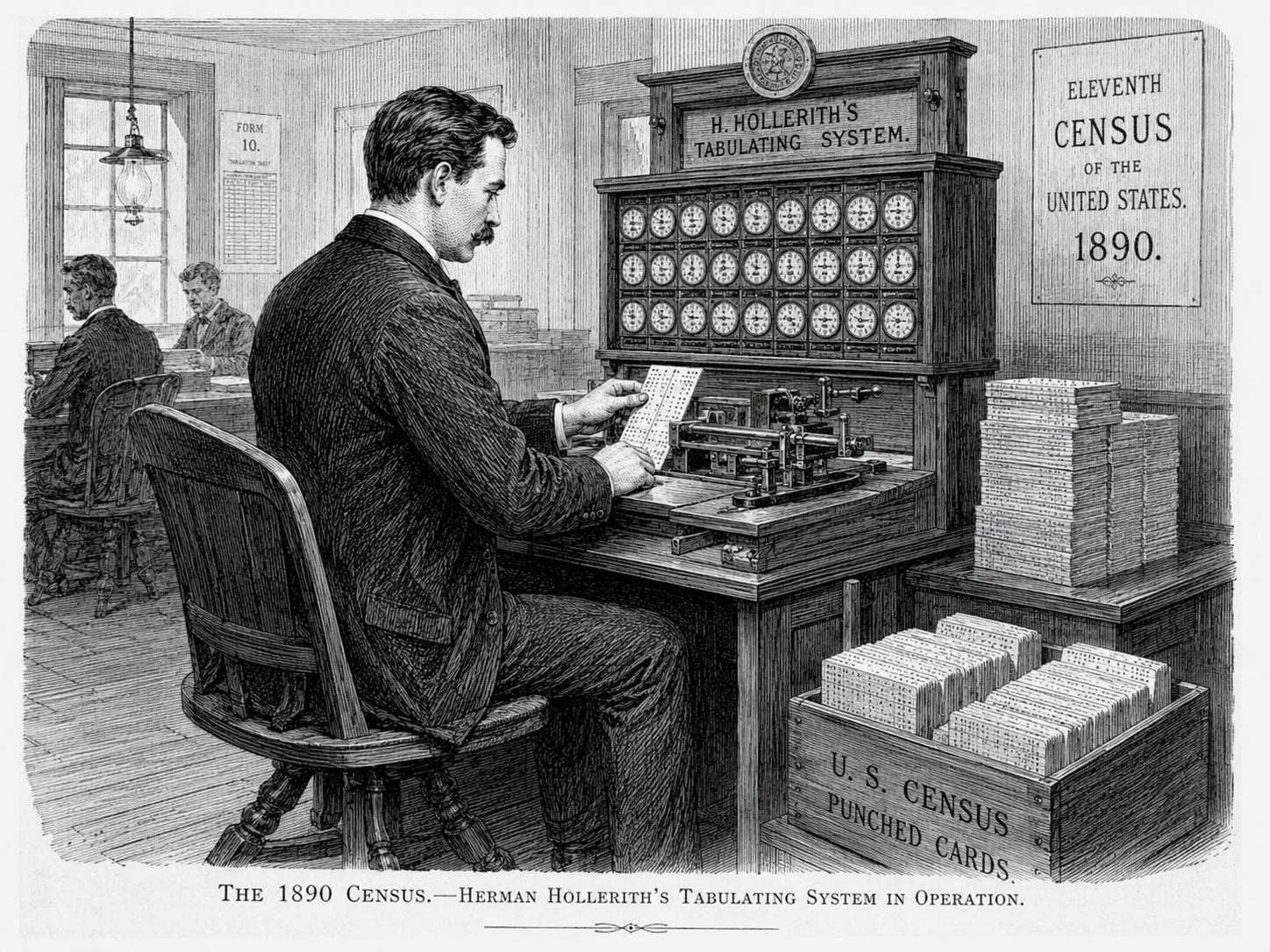
Why punch cards? Well, they already solved the problem for the Jacquard Loom, preprogramming a machine to follow an intricate weave pattern. That’s really just a data processing problem—the machine needs to know to put a stitch over here but not over there, yes or no. The same is ultimately true for tabulating census data—this bit of data goes into this category, not that one.
Hollerith had also noticed that railroad conductors would punch a ticket to indicate where a traveler was headed and by what type of car. He simply put two and two together and came up with an elegant solution that would work.
Hollerith’s machine destroyed the competition, and the relationship between the US and computer manufacturers began in earnest. The company he founded would be acquired by the Computing-Tabulating-Recording Company (CTR) in 1911, and that company would go on to change its name to International Business Machines (IBM) in 1924.
If you want to read more about the solution to the 1890 census, I wrote about this a couple years ago:

The poor British Empire. The beginning of the end? Or was it the fall of colonialism? Or was that when they left the EU?
What will they do next