
Dust

Dust is surely where we all end up. All the great poets and philosophers seem to know it:
For you are dust, and to dust you shall return. — Genesis 3:19
I will show you fear in a handful of dust.
—T. S. Eliot, The Waste Land (1922)
Later, at the funeral, when the preacher said ‘Dust to dust,’ some people laughed, and the cowboy shot them.
—Jack Handey
Alley and I can vouch: when we dug up Hallie’s body to move her, the bones were already crumbling away after being buried for six or seven years. Hallie was turning back into dust before our eyes.

What, though, is dust? Materially, I mean.
What’s dust made of?
The answer seems disappointing at first: it’s made up of a variety of stuff. Anything made of solid matter that becomes tiny and uniform can join the dust party, and that can be a tremendous amount of different things.
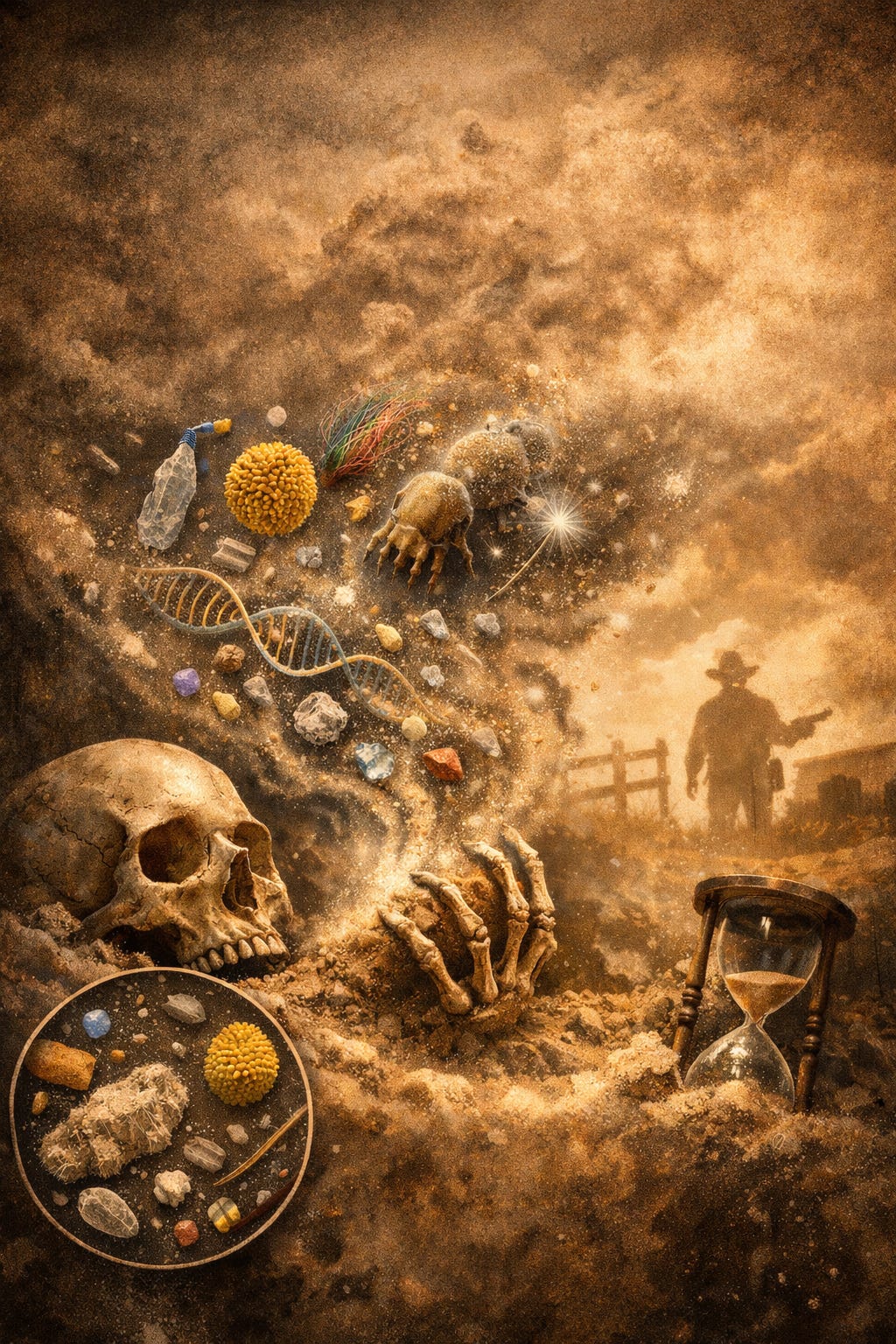
One way to categorize dust is with indoor and outdoor types; this is useful since outdoor dust is generally predominated by particles from the soil, dirt, or sand—basically, whatever the ground is made up of. Indoor dust still has a bit of this, but there’s a lot more rounding out and less of a concentration of particles of the earth.
When you see a mote of dust, it might be a suspended particle from the soil that was blown or tracked in, but it might just as likely be a microplastic morsel or a biological booger.
TL;DR: dust isn’t so much of a substance as a classification of particles based on size.
Of course, I can't let you forget this: https://www.youtube.com/watch?v=tH2w6Oxx0kQ
I had never thought about the comment ‘dust to dust’ and now thinking of David Bowie!